
I’ve been eating for my MS since 2004. That’s over two decades of adjusting, listening, learning, and yes, sometimes getting it wrong. And the single biggest thing those years have taught me?
There is no perfect diet for MS gut health.
I know that might not be what you were hoping to hear. But stay with me — because I think it’s actually the most freeing thing I can tell you.
What the Research Is Finally Saying About MS Gut Health
The connection between the gut and multiple sclerosis is one of the most exciting areas of MS research right now. Scientists now understand that people with MS have measurably different gut microbiomes than healthy controls — and that those differences may influence inflammation, immune function, and even how the disease progresses over time.
But here’s what keeps coming up across study after study: the strongest patterns are not about one supplement or one elimination diet. They point toward a combination of things working together, consistently, over time.
What keeps showing up in the research on MS gut health:
- High-fiber vegetables and wide plant diversity
- Fewer ultra-processed foods
- Better sleep
- Lower chronic stress
- Regular movement
- Microbiome diversity — not trying to “kill everything”
- Personalization, because people respond differently
- Consistency over months, not days
Not a single magic fix. A lifestyle ecosystem.
🌿 Healing Tip:
Adding just one new plant food per week — a new herb, vegetable, or fruit — is one of the easiest ways to begin building microbiome diversity without overhauling your entire diet at once.
The Gut Doesn’t Work Alone
Here’s something researchers are now talking about constantly: the gut-brain axis — and even more specifically, the gut-brain-sleep axis. This is the two-way communication highway between your digestive system and your central nervous system.
What this means:
- Poor sleep disrupts the gut microbiome
- Chronic stress disrupts the gut microbiome
- Ongoing inflammation disrupts the gut microbiome
- And the microbiome, in turn, sends signals back to the brain and nervous system
So if you’ve been doing “everything right” with your diet and still struggling, this might explain why. The gut doesn’t heal alone. If one part of the cycle keeps disrupting the others — say, chronic stress, poor sleep, or nervous system overload — gut health efforts can stall no matter how clean your eating is.
For me personally, I believe the gut-brain axis affected me most. Years of chronic stress, disrupted sleep, nervous system overload, and long stretches of living in survival mode all left their mark on my gut — and no amount of kale was going to fix that on its own.
Researchers now believe chronic stress can physically change gut permeability, digestion, inflammation signaling, and microbiome balance. That was a lightbulb moment for me.
🌿 Healing Tip:
Before bed, try 5 minutes of slow, deep breathing or gentle stretching. Calming the nervous system at night supports both sleep quality and gut microbiome balance — two things that directly affect MS gut health.
Stop Eliminating. Start Building.
For years, most gut-healing advice for people with MS centered on removing things:
- Eliminate trigger foods
- Restrict certain food groups
- Avoid anything inflammatory
- Kill pathogens
- Cleanse and detox
And some of that has real value. But researchers are now emphasizing that it’s equally important — maybe more important — to focus on building:
- Feeding beneficial bacteria
- Increasing microbial diversity
- Supporting short-chain fatty acid production
- Creating stability and resilience in the gut ecosystem
This is why foods like leafy greens, cruciferous vegetables, berries, flaxseed, herbs and spices, and resistant starches keep appearing in MS gut health research. They are builders. They feed the system rather than just eliminating from it.
A 2026 study published in the journal Nutrients specifically found associations between short-chain fatty acid-producing gut bacteria and better outcomes in people with relapsing-remitting MS, including slower disability progression and better quality of life measures. (Read the study here)
When “Healthy” Foods Still Cause Trouble
This is something not enough people talk about, and I want to say it clearly: some people with long-term MS develop a gut that has become extremely sensitive from years of inflammation. For those of us in that category, even genuinely healthy foods can trigger symptoms temporarily.
That’s not failure. That’s information.
Researchers are beginning to look more at nervous system regulation, vagus nerve activity, and the importance of slow rebuilding rather than aggressive dietary overhauls. If your gut feels reactive and unpredictable, that may be less about which foods you’re eating and more about an overactivated stress response and a nervous system that needs calming first.
There may not be one “perfect” microbiome to achieve. The real goal may be creating a stable, resilient ecosystem — not a spotlessly clean gut.

Why Spending Time in Nature Matters
You know that feeling when you sit outside and everything just… softens? Your shoulders drop. Your breath slows. The tension you didn’t even realize you were carrying starts to melt away.
🌿 Healing MS Naturally Outdoors
Healing Is Not Linear
When I think back on my own journey, progress never looked like I expected it to. Healing in chronic neurological conditions tends to look less like “everything suddenly fixes” and more like reducing the total inflammatory burden, little by little, over time.
When my severe dry mouth finally improved, it happened so gradually that I didn’t even notice until I found an old symptom list I’d written earlier. That kind of quiet, slow progress is easy to miss — and easy to dismiss as “not working.”
But if your digestion has improved, your energy has shifted, your hydration is better — those are signals. Your body is responding, even if it doesn’t feel like complete healing yet.
🌿 Healing Tip:
Write down three symptoms you’re currently experiencing and date it. Revisit that list in six months. Slow progress often only becomes visible when you look backward.
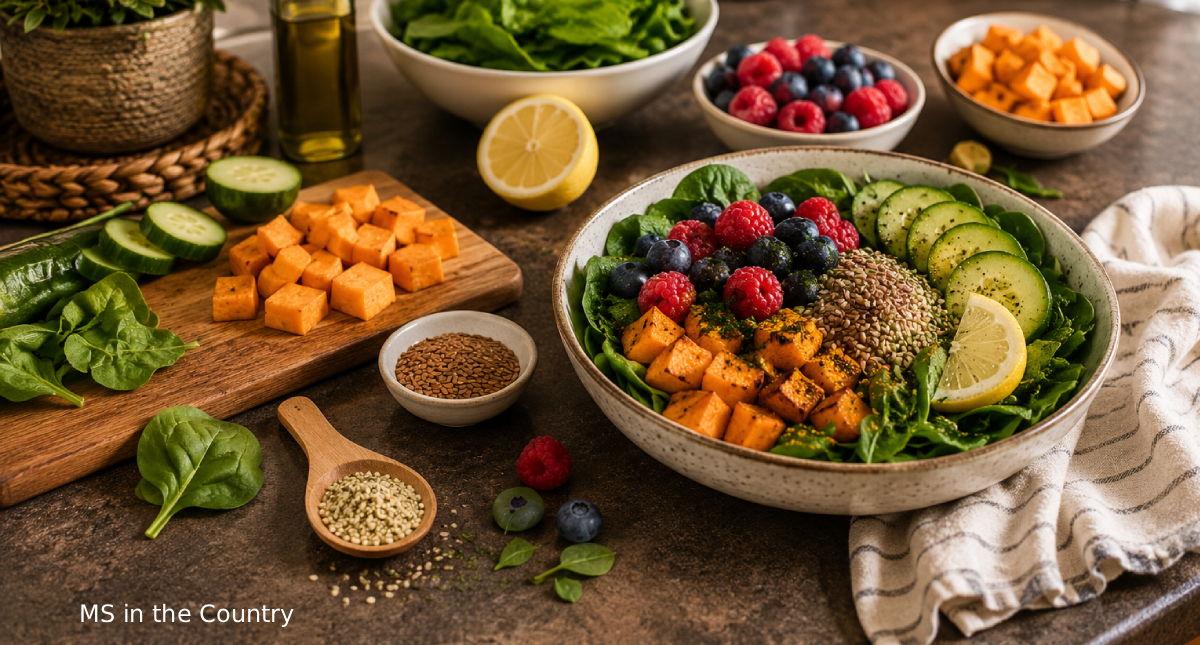
Something You Can Do Today: A 5-Minute Microbiome Bowl
I am a firm believer in extremely easy food that still tastes genuinely delicious. Because if it takes too much energy, we won’t do it — and consistency is the whole point.
Here’s a no-cook, diet-flexible recipe that works regardless of whether you’re following the Wahls Protocol, OMS, or your own personalized approach:
🥣 The 5-Minute MS Gut Health Bowl
What you need (serves 1):
- 1–2 large handfuls of leafy greens (spinach, arugula, or mixed greens)
- ½ cup cooked and cooled sweet potato, cubed or mashed (roast a batch ahead — see tip below)
- A handful of fresh or frozen-then-thawed berries
- 1–2 tablespoons of flaxseed or hemp seeds
- A drizzle of good olive oil
- A squeeze of fresh lemon
- Optional: a pinch of turmeric, a few fresh herbs, or sliced cucumber
What you do: Put it all in a bowl. That’s it.
Make-ahead tip: Roast a tray of sweet potato cubes at the start of the week and keep them in the fridge. Once cooled, the starch in sweet potato converts into resistant starch — which your gut bacteria actually ferment and use as fuel, making it a natural prebiotic. Cold from the fridge is perfect.
Why it works for MS gut health: Leafy greens and berries feed beneficial gut bacteria. Flaxseed provides omega-3 fatty acids and fiber that support short-chain fatty acid production. Cooled sweet potato delivers resistant starch that functions as a prebiotic. Olive oil provides anti-inflammatory polyphenols. And the variety of plant foods — even in one small bowl — contributes to that microbiome diversity the research keeps pointing back to.
No specialty ingredients. If you’ve got sweet potato already cooked and cooled in the fridge, this comes together in five minutes on even a low-energy day.
The Mindset Shift That Made the Biggest Difference
Here’s something I want to leave you with, because I think it matters as much as anything on that ingredient list.
One of the most powerful things I did for my MS gut health had nothing to do with food. It was learning to calm my nervous system — not just by reducing external stress, but by changing how I responded to stress, and genuinely shifting how I talked to myself.
Over many years in MS communities online, I noticed something: groups that focused primarily on medications tended to carry more fear, anger, and negative emotional language than groups focused on natural and lifestyle approaches. I’m not saying one path is right for everyone. But that observation stayed with me.
The question I started asking myself — and that I’d gently offer to you — is this:
Instead of “What’s wrong with me today?” — what if you asked, “What can I do today to help myself?”
That one small shift in framing can begin to calm the nervous system in real time. And that, it turns out, may be one of the best things you can do for your gut.
The information in this post is based on personal experience and publicly available research. It is not medical advice. Always work with your healthcare team when making changes to your MS management plan.
Did something in this post resonate with you? Drop a comment below — I’d love to hear where you are in your own MS gut health journey.