
After 35 years of living in a rural area and healing MS naturally outdoors, some of my best “treatments” don’t come from a pharmacy. They come from my front porch.
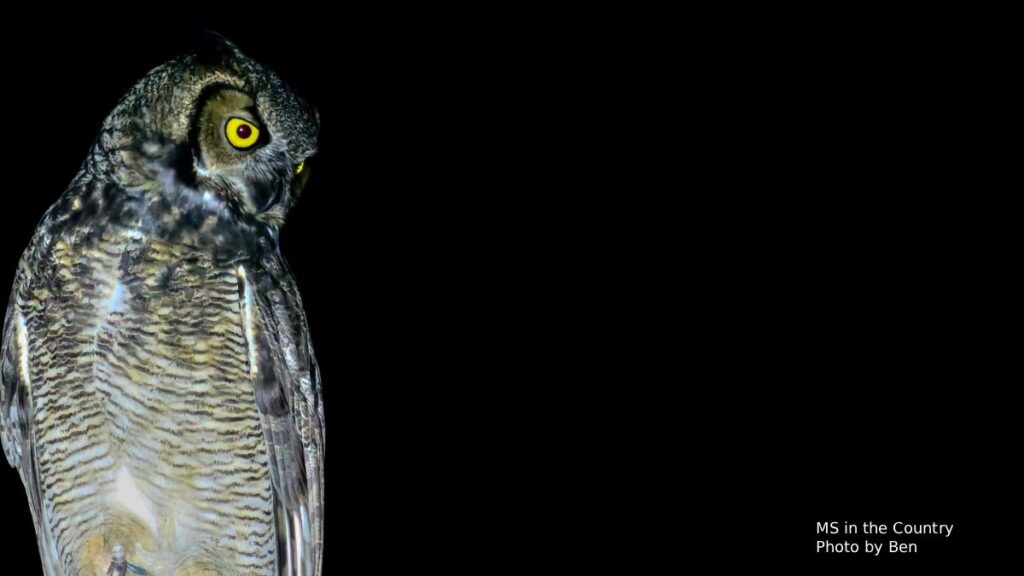
On the best days, I sit in my rocking chair, and there is literally nothing to hear except the rustle of leaves in a breeze. The hawks soar overhead in slow, lazy circles. The great horned owls who live in our trees call to each other as the sun goes down. The meadowlarks sing. The quail holler what sounds to me exactly like “WHERE ARE YOU” — every single time, it makes me laugh.
In 35 years out here, I’ve watched triple rainbows arc across the sky, dust devils spinning red earth 1,000 feet into the air, and a blanket of billions of stars you simply cannot see from a city. Even the creatures that make some people step back — praying mantises, spiders, snakes — turn out to be helpful neighbors out here. Praying mantises eat black widow spiders. Wolf spiders quietly take care of pests like earwigs. Bull snakes keep rattlesnakes away. Nature out here isn’t background scenery. It is alive. It is busy. And it is magnificent.
And for those of us with MS? It turns out it may be one of the most powerful tools we have.
This Earth Day, I also want to share some exciting new research that finally explains why spending time in nature feels so good for our brains, our nervous systems, and our immune systems. Spoiler: your instincts have been right all along.
Healing MS Naturally Outdoors: What Quiet Does to Your Nervous System
You know that feeling when you sit outside and everything just… softens? Your shoulders drop. Your breath slows. The tension you didn’t even realize you were carrying starts to melt away.
That’s not your imagination. That is your parasympathetic nervous system (your “rest and repair” system) finally getting a chance to do its job.
For people with MS, this matters enormously. Chronic stress activates the sympathetic nervous system (fight-or-flight), which drives inflammation, and inflammation is the engine behind MS relapses and progression. Natural quiet is one of the most effective ways to shift your body out of that inflammatory state.
Research published in the Proceedings of the National Academy of Sciences found that people who walked in natural settings showed significantly lower activity in the part of the brain associated with rumination (repetitive negative thinking) compared to those who walked in urban environments. Less rumination = less stress response = less inflammation. Simple. Profound.
🌿 What you can do:
Even 20 minutes of sitting quietly outside (no phone, no podcast) has been shown to meaningfully lower cortisol levels. You don’t need a mountain view (though if you have one, use it!). A backyard, a park bench, or even an open window with natural sounds can start to shift your nervous system toward calm.
That Warm Sun on Your Skin Is Doing Real Biological Work
One of my favorite things about warmer days is feeling the sun on my face and arms while I’m rocking on my porch. And it turns out that warmth is genuinely medicinal for people with MS.
Vitamin D, which your skin produces when exposed to sunlight, is one of the most studied nutrients in MS research. It binds to vitamin D receptors throughout the immune system, supports regulatory T-cells (the immune cells that help tell your body to calm down), and helps suppress the kind of pro-inflammatory activity that drives MS disease activity. Low vitamin D levels are now recognized as one of the most consistent environmental risk factors for developing MS in the first place.
But here’s something that doesn’t get said enough: sunlight does more than just produce vitamin D. Natural light also syncs your circadian rhythm (your body’s internal clock), which regulates sleep quality, hormonal balance, energy levels, and gut function. All systems that MS disrupts. All systems that natural light helps restore.
🌿 What you can do:
Aim for 15–30 minutes of sun exposure on your arms and legs during mid-morning when UV levels are moderate.
Here’s something important I want every MS reader to know: most doctors only test for deficiency, not for the optimal range that MS patients actually need. Research shows vitamin D deficiency doubles MS risk, yet standard labs will tell you 30 ng/mL is “normal” and send you on your way — this happened to me. For MS, that’s not good enough.
I wrote an entire healing guide on exactly this topic — “Vitamin D and MS: Why ‘Normal’ Isn’t Good Enough.” It covers the optimal range for MS (hint: it’s not 30–40 ng/mL), what form to take, how much to supplement, and what to do when your doctor won’t order the right test. It’s part of my MS Healing Guides series, and it’s just $3.99.
👉 Get the Vitamin D & MS Healing Guide here
And as always, check with your neurologist about your levels before adjusting your supplementation.
Important note for heat-sensitive MS folks: If heat worsens your symptoms (Uhthoff’s phenomenon), early morning or evening sun is your friend. The goal is light, not heat. A shaded porch with dappled sunlight still delivers real benefits.
For many people with MS, healing MS naturally outdoors may be as simple as spending time in nature, where the nervous system, immune system, and even gut bacteria benefit all at once.
🌿 Healing Tip:
If heat tends to make your symptoms worse, you might also want to look at MSSA’s Cooling Distribution Program. This program helps people living with MS get access to cooling items like vests, neck wraps, and scarves designed to help lower body temperature. Staying cool can make it much easier to spend time outdoors and enjoy nature without triggering heat-related symptoms.
Forest Bathing, Your Immune System, and a Great Horned Owl
OK, I have to tell you this story because it ties together perfectly.
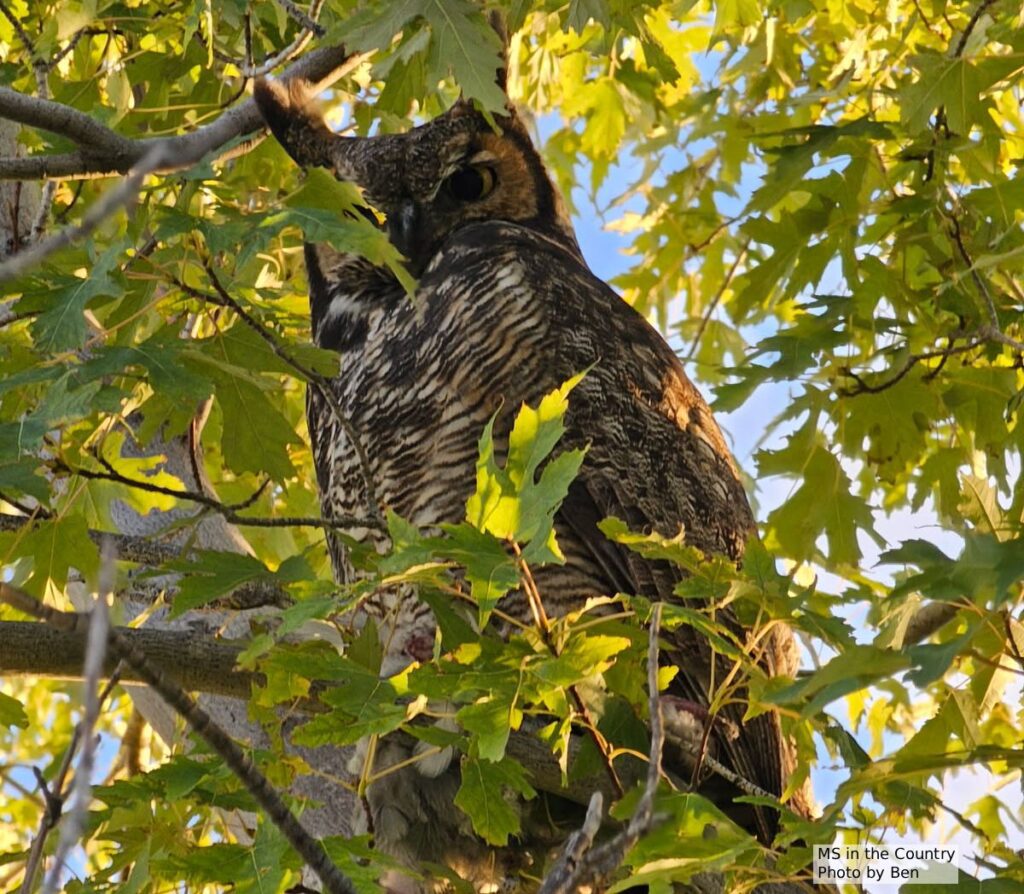
My son wanted a close-up photo of the great horned owl who lives in our trees. So he climbed up on top of our pile of road mix to get closer. The owl watched him the whole time — didn’t budge, didn’t fly away. We think he was used to us. My son got the most incredible shot (photo above).
Then the owl flew down to the ground, grabbed a rabbit, carried it up to the top of our power pole, and proceeded to… well. The rabbit screamed. It was horrible to listen to. But as they say, that’s nature.
Here’s why I’m telling you this story in the section about your nervous system: those trees where our owl roosts are doing something remarkable. Trees release compounds called phytoncides — essentially the forest’s own immune system chemicals, released to protect themselves from bacteria and insects. When we breathe them in, something remarkable happens in our bodies: they stimulate our natural killer (NK) cells to increase in number and activity.
NK cells play a direct role in MS. Research has found that lower NK cell activity is associated with more frequent relapses. Spending time among trees (especially conifers like pine and cedar) naturally boosts these cells. Studies from Japan, where the practice of Shinrin-yoku (forest bathing) has been formally researched for decades, have shown that a single 2-hour walk in a forested area can increase NK cell activity for up to 30 days.
Thirty days. From one walk.
A 2025 study also found that forest bathing significantly reduced depression scores compared to city walking, and since depression affects up to 50% of people with MS, that finding hits close to home for many of us.
🌿 What you can do:
You don’t have to go deep into the wilderness or go for a 2 hour walk. A neighborhood park with mature trees, a backyard with pines, or even potted cedar on a patio releases phytoncides. The practice is simple: slow down, breathe deeply, and just be among the trees. No fitness goals. No step counts. Just presence.
The Earth Day Connection You Didn’t Expect: Your Gut and the Soil
Here’s where things get really interesting, and where Earth Day connects to MS in a way that might surprise you.
A landmark 2025 twin study published in PNAS (one of the most prestigious scientific journals in the world) compared the gut microbiomes of 81 pairs of identical twins where only one twin had MS. Because identical twins share the same DNA, any differences in their gut bacteria reflect environmental choices — not genetics. The researchers identified specific bacterial strains linked to MS disease activity.
What does this have to do with Earth Day? Everything.
The gut microbiome (that vast community of trillions of bacteria living in your digestive system) is deeply shaped by how close we live to the natural world. Diets rich in diverse, fiber-rich whole foods (the kind that come from healthy soil) feed the beneficial bacteria that keep inflammation in check. Processed, low-fiber “Western” diets do the opposite.
The Earth gives us food that feeds the bacteria that regulate our immune systems. When we disconnect from real, whole food (food that looks like it came from the ground rather than a factory), we pay a price at the microbial level. And for people with MS, that microbial imbalance may literally influence disease activity.
What you can do: This Earth Day, make one gut-friendly swap. Add one more serving of vegetables, legumes, or whole grains to your day. If you have access to a garden or farmers market, even better — diverse plant foods = diverse gut bacteria = better immune regulation. It’s a beautiful, simple chain that starts with the soil.
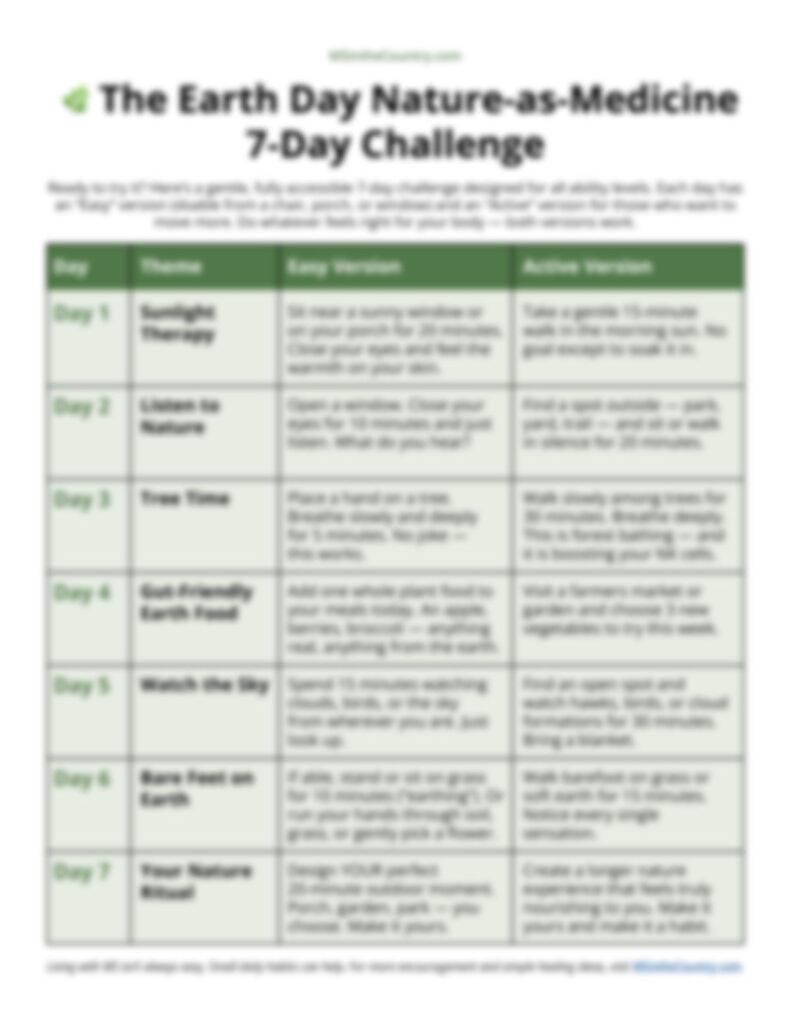
🌿 The Earth Day Nature-as-Medicine 7-Day Challenge
Want the printable version of this challenge?
Download the free PDF and keep it nearby during the week. 👇
Ready to try it? Here’s a gentle, fully accessible 7-day challenge designed for all ability levels. Each day has an Easy version (doable from a chair, porch, or window) and an Active version for those who want to move more. Do whatever feels right for your body — both versions work.
Day 1 — Sunlight Therapy
- 🪑 Easy: Sit near a sunny window or on your porch for 20 minutes. Close your eyes and feel the warmth on your skin.
- 🚶 Active: Take a gentle 15-minute walk in the morning sun. No goal except to soak it in.
Day 2 — Listen to Nature
- 🪑 Easy: Open a window. Close your eyes for 10 minutes and just listen. What do you hear?
- 🚶 Active: Find a spot outside (park, yard, trail) and sit or walk in silence for 20 minutes.
Day 3 — Tree Time
- 🪑 Easy: If you can reach a tree, place your hand on the bark. Breathe slowly and deeply for 5 minutes.
- 🚶 Active: Walk slowly among trees for 30 minutes. Breathe deeply. This is forest bathing, and it is boosting your NK cells.
Day 4 — Gut-Friendly Earth Food
- 🪑 Easy: Add one whole plant food to your meals today. An apple, some berries, a handful of broccoli — anything real, anything from the earth.
- 🚶 Active: Visit a farmers market or garden and choose 3 new vegetables to try this week.
Day 5 — Watch the Sky
- 🪑 Easy: Spend 15 minutes watching clouds, birds, or the sky from wherever you are. Just look up.
- 🚶 Active: Find an open spot and watch hawks, birds, or cloud formations for 30 minutes. Bring a blanket.
Day 6 — Bare Feet on Earth
- 🪑 Easy: If able, stand or sit on grass for 10 minutes. Or simply run your hands through soil or grass.
- 🚶 Active: Walk barefoot on grass or soft earth for 15 minutes. Notice every single sensation.
Day 7 — Your Nature Ritual
- 🪑 Easy: Design YOUR perfect 20-minute outdoor moment. Porch, garden, park — you choose.
- 🚶 Active: Create a longer nature experience that feels truly nourishing to you. Make it yours and make it a habit.
I’d love to see your challenge moments! Share a photo on social media and show me what nature looks like from your corner of the world. Every one of these moments is medicine. 💚
The Bottom Line: Earth Day Is an MS Awareness Day
Science is catching up to what many of us have known for years: we are part of nature, not separate from it. Our immune systems evolved in the outdoors. Our nervous systems expect natural quiet. Our gut microbiomes were shaped by real, whole food from the soil. Our skin was made to feel sunlight.
When we step outside (even just onto a porch, even just to listen to the wind in the leaves) we are giving our bodies something they have been designed, at a cellular level, to receive.
I’ve spent 35 years watching nature in all its forms. The jaw-dropping beauty and the brutal honesty. Antelope wandering across our property at sunrise. Hundreds of hawks lifting from the trees at once, filling the sky with wings. Meteor showers so bright we sometimes saw three shooting stars at the same time. And sunsets that turn the whole horizon into a sky of fire.
But nature out here isn’t only gentle. We’ve watched range fires race across the land, winds strong enough to throw wood through a windshield, and coyotes remind us that life in the wild is never tame. Even cheatgrass finds its way into shoes, socks, and paws.
Nature doesn’t sugarcoat anything. But it may be one of the most powerful tools we have for healing MS naturally — if we let it.
This Earth Day, step outside. Even for 20 minutes. The earth is waiting. 🌿
Medical Disclaimer: This post is written from personal experience and for informational purposes only. It is not medical advice. Always consult your neurologist before making changes to your MS management plan. If you experience heat sensitivity (Uhthoff’s phenomenon), take appropriate precautions in warm weather.
🍃 Get the Free Printable 7-Day Nature Challenge
Spend 7 gentle days reconnecting with nature. This printable guide includes simple daily activities you can do from a chair, porch, or outside.
Join my MS in the Country newsletter for gentle reminders, healing tips, and simple ideas to help you spend more time outside and support your body while healing MS naturally outdoors.
Download the 7-Day Nature Reset Guide below and begin reconnecting with fresh air, sunlight, and peaceful outdoor moments that help your body recharge. 👇

Comments
2 responses to “Healing MS Naturally Outdoors: Why Spending Time in Nature Matters This Earth Day”
Loved the owls!
Thanks!