If you’ve recently been diagnosed with multiple sclerosis and started researching what to eat with MS, you’ve probably already discovered something frustrating: everyone has a different answer. The Wahls Protocol says this. The Swank Diet says that. The OMS program has its own list. Some tell you to cut out gluten. Others say cut out legumes. A few eliminate nightshades. Many eliminate everything that makes food enjoyable.
And then there’s the moment that I think most of us have experienced — you’ve just spent an hour researching what to eat with MS, and you still don’t know what to make for dinner.
The books tell you what to avoid. They tell you what’s “allowed.” But they don’t always tell you what to actually do with the food in front of you, or how to make it work in your real life, on a random day, when you’re tired and just want something simple.
I’ve been living with MS for what feels like most of my life. I started eating not just “healthy” foods, but whole nutritious foods, in 2004, and for over a decade I chased the perfect MS diet — trying one protocol, then another, then another. It wasn’t until 2015 that I finally let go of that search and had a realization that changed everything: there is no perfect MS diet. There is only the diet that works for your body.
This post is about what that looks like for me today — what I actually eat in a real day — and why I believe that listening to your body is more powerful than following any book.
First, a Word About MS Diets
Before I go any further, I want to be clear about something: I am not here to cut down any specific MS diet. The Wahls Protocol, Swank, OMS, and others have genuinely helped many people, and I have tremendous respect for that. These approaches are grounded in real research and real results for real people.
The issue isn’t that they don’t work. The issue is that they don’t work for everyone — and I happened to be one of those people.
While following strict MS diets over the years, I kept losing weight. No matter what I tried, I couldn’t stop the loss. At my lowest, I was 15 pounds underweight, and I couldn’t figure out how to gain it back while staying within the rules of whatever protocol I was following. My weight didn’t stabilize until I stopped following strict food rules and started listening to what my body needed. Today I’m at a healthy weight for my height, and I’ve stayed there.
I share this not to discourage anyone from trying a structured MS diet, but because I suspect I’m not the only one who has experienced this. If you’re following an MS diet and finding yourself underweight, or you’re not seeing the results you were hoping for, it may be worth considering whether a more flexible, personalized approach might serve your body better.
The Problem With MS Diets (And Why I Stopped Following Them)
When I first started changing how I ate, I did what most people do: I found a book, followed the rules, and hoped for the best. The book had good intentions. It told me what to eat and what to avoid. But it didn’t hand me a meal. It didn’t tell me what to do with a bunch of kale and some leftover chicken on a busy day.
Over the years, I tried many different approaches to eating with MS. Each one promised results. Each one had compelling science behind it. And each one left me feeling like I was either doing it wrong or that I simply couldn’t maintain such a rigid way of eating forever.
The turning point came gradually. I started paying closer attention — not to what a book said, but to how I felt after eating certain foods. I started noticing patterns. I started making small adjustments. And then something happened that I genuinely did not expect.
About three months after I shifted my diet and added supplements, including vitamin D, my heat intolerance disappeared.
Vitamin D and MS: Why “Normal” May Not Be Enough
Learn what current research says about vitamin D levels, fatigue, immune health, and feeling your best with MS.
If you have MS, you know what heat intolerance means. Going outside on a hot day, taking a warm shower, even a brisk walk — all of it could trigger a worsening of symptoms. It had been part of my life for so long that I had simply accepted it as permanent.
But it was gone. I didn’t trust it at first. I went outside on hot days repeatedly, almost testing it, waiting for the familiar wave of fatigue and weakness. It didn’t come. It was one of the most surprising things that has happened to me in all the years of living with this disease, and it came not from a medication, but from food and a few targeted supplements.
That experience taught me something important: the body responds. It gives you feedback. The key is learning to listen.
The Histamine Lesson: When “Healthy” Foods Aren’t Healthy for You
Here’s something that took me years to figure out, and I share it because I’ve never seen it discussed enough in MS diet circles.
For a long time, I struggled with a recurring rash on my hands and face. I tried to figure out what was causing it, but the answer kept eluding me. It felt like the more foods I eliminated, the more I struggled. It took a few years of paying close attention before I finally connected the dots: the rash was being triggered by foods high in histamine.
The frustrating part? Many of those foods were considered “healthy.” Sauerkraut — a gut health staple. Leftovers — convenient and practical. Tomatoes and spinach — two vegetables practically synonymous with eating well. All of them were contributing to a rash that I had been dealing with for years.
Once I eliminated high-histamine foods, the rash went away.
The story doesn’t end there, though. Years later, as I gradually reintroduced foods, something interesting happened: I can now eat spinach and tomatoes without a reaction. My body, it seems, changed over time. I’m still careful not to eat too much at once — just in case — but the severe sensitivity that once defined my diet is no longer there.
This is why I keep coming back to the idea of listening to your body over following rules. No MS diet book would have told me about histamine intolerance. Only consistent, curious attention to my own body could do that.
If you’re eating a diet full of foods that are technically “healthy” but something still feels off — whether it’s a skin reaction, digestive discomfort, fatigue, or something else — it may be worth looking into whether specific foods are causing a reaction unique to you.
Why There Is No Perfect MS Diet — And That’s Okay
The MS diet conversation can feel overwhelming, especially when you’re newly diagnosed and desperate for answers. You want someone to hand you a plan and tell you that if you follow it perfectly, you’ll be okay.
But the truth is, everybody is different. What triggers inflammation in one person may be completely fine for another. Food sensitivities vary. Gut microbiomes vary. Lifestyles vary. What works beautifully for someone sharing their success story online may not work the same way for you — and that doesn’t mean you’re doing it wrong.
What most MS-friendly diets do agree on, underneath all their specific rules, is a core set of principles:
- Eat more whole, unprocessed foods
- Prioritize vegetables and fruits
- Reduce sugar and refined carbohydrates
- Support gut health
- Reduce foods that promote inflammation
Those principles are the foundation. Everything else is personal.
My own diet has shifted considerably over the years, and I think that’s healthy. I added beans back in — and my body handles them well. I reintroduced certified gluten-free oatmeal, and that’s been fine too. On the other hand, I stopped drinking lemon water, which I had been doing for years, because I noticed it was causing me to lose my voice. Once I stopped, the problem went away. No book told me that. My body did.
Figuring out what to eat with MS is less about finding the right protocol and more about finding what works for your specific body. That kind of self-awareness is, I believe, the most valuable tool anyone with MS can develop around food.
What I Actually Eat in a Day With MS
I want to be clear that this is not a meal plan. This is not an eat-this, avoid-that diet. This is simply one real day of eating for one person who has spent decades figuring out what works for her body. Take what’s useful, leave what isn’t, and use it as inspiration for finding what works for yours.
I only recommend eating whole foods and avoiding highly processed foods and dairy. Many studies have found that people with MS who consume more dairy have more relapses.
I also want to mention that I don’t spend a lot of time in the kitchen anymore. When I was younger, I enjoyed spending time in the kitchen cooking. These days, I keep it simple. One pan. A bowl. Easy cleanup. Real food doesn’t have to be complicated.
Here’s an example of what I ate yesterday:
Breakfast: Smoothie
My mornings usually start with a smoothie. It’s quick, easy to digest, and a wonderful way to pack in nutrients without standing over a stove.
Here’s a tip I’ve learned over the years that makes a real difference: I add cauliflower rice to my smoothies. You truly cannot taste it, but it adds fiber and nutrients without changing the flavor at all. I also add 6 to 8 cups of leafy greens — which sounds like a lot, but there’s a trick. I blend the greens with water first, before adding the other ingredients. This breaks them down completely and makes room in the blender for everything else. Finish with fruit for natural sweetness, ground flaxseeds for omega-3s, and whatever else you like.
Smoothies are particularly useful when MS fatigue makes the idea of preparing a full meal feel like too much. Having a routine that’s fast and genuinely nourishing is worth its weight in gold on harder days.
🌿 Healing Tip:
Blend your leafy greens with water first before adding other ingredients. It breaks them down completely, makes room in the blender, and ensures you’re actually absorbing the nutrients rather than swallowing large chunks.
Mid-Morning Snack: Papaya, Cucumber, and Kiwi With Fresh Lime Juice
This is the kind of snack that sounds fancy but takes about two minutes to prepare. Slice up some papaya, add cucumber slices and kiwi, and squeeze fresh lime juice over the top. That’s it.
Papaya is rich in antioxidants and has natural anti-inflammatory properties. Cucumber is hydrating and easy on digestion. Kiwi is loaded with vitamin C. The lime juice ties everything together while adding a bright, fresh flavor without any sugar.
This is what eating healthy looks like in practice. It doesn’t have to be a complicated recipe. It’s real food, combined simply, eaten with intention.
Lunch: Big Salad Bowl With Avocado Dressing
Lunch was a large salad bowl with leftover chicken pieces, shredded red cabbage, radishes, sliced cucumbers, grape tomatoes, and dried oregano. The dressing was made with avocado, fresh lemon juice, and a little water blended together until smooth and creamy.
I usually eat meat at lunch, not dinner. This is intentional. A heavier protein like chicken is easier for your body to digest when you have the rest of the day ahead of you. By keeping dinner lighter, I give my digestive system time to wind down before sleep, which I’ve found makes a real difference in how I feel the next morning.
For the dressing, avocado is my favorite base, but I also love plain lemon juice on its own, or orange juice mixed with a little raw honey. That orange juice and honey combination is simple and delicious and feels like a treat without being one.
Making your own dressing takes two minutes and means you know exactly what’s in it — no seed oils, no additives, no mystery ingredients.
🌿 Healing Tip:
Making your own salad dressing takes two minutes and means no hidden seed oils, additives, or preservatives — ingredients that can quietly work against an anti-inflammatory diet.
Dinner: Roasted Cauliflower and Broccoli Bowl With Turmeric-Lemon Dressing
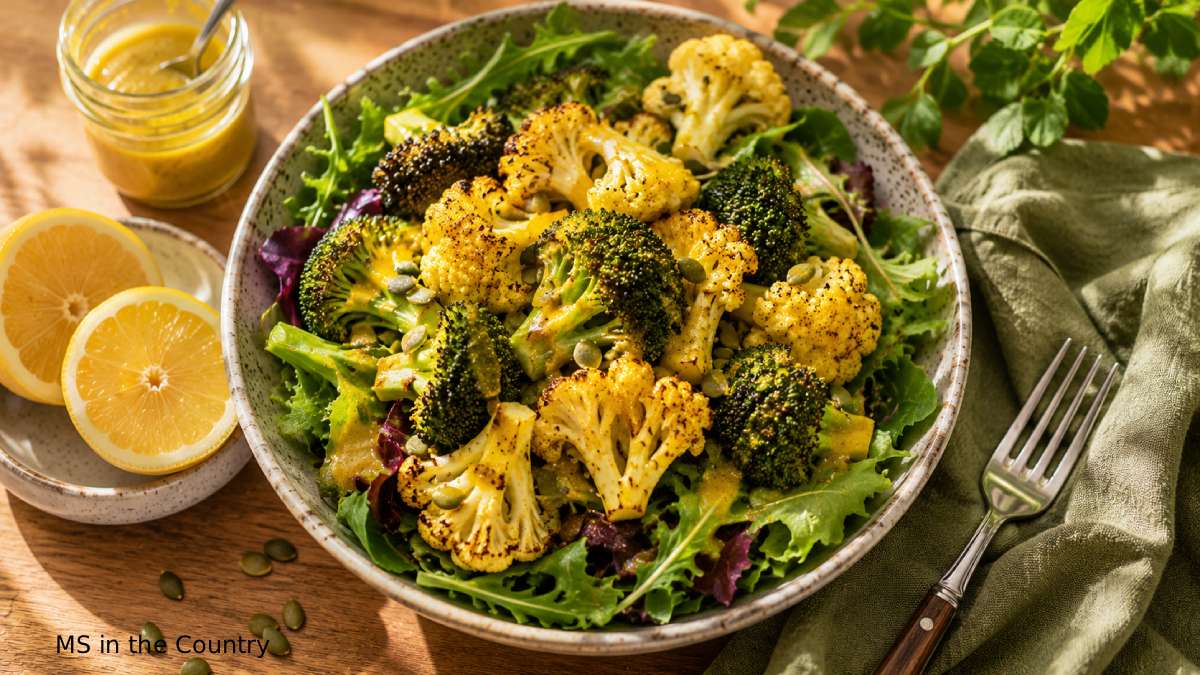
Dinner was a roasted cauliflower-and-broccoli bowl served over leafy greens, with a turmeric-lemon dressing and ground flaxseeds sprinkled on top. This is the one-pan meal I was talking about — minimal prep, minimal cleanup, genuinely satisfying.
Roast the cauliflower and broccoli with a little olive oil until golden and tender. Meanwhile, whisk together olive oil, fresh lemon juice, turmeric, and a pinch of black pepper. I’ll be honest — I’m not usually a fan of turmeric, but this dressing was surprisingly good. Sometimes the simplest combinations catch you off guard. Pour it over a bowl of leafy greens, top with the roasted vegetables, and finish with ground flaxseeds.
Turmeric is one of the most researched natural anti-inflammatory ingredients available. Flaxseeds are an excellent plant-based source of omega-3 fatty acids. Cruciferous vegetables like broccoli and cauliflower support detoxification and gut health. This bowl is simple, nourishing, and easy enough to make even on a low-energy day.
This is not a starvation diet. If you need to eat more or less, then do it; everyone is different.
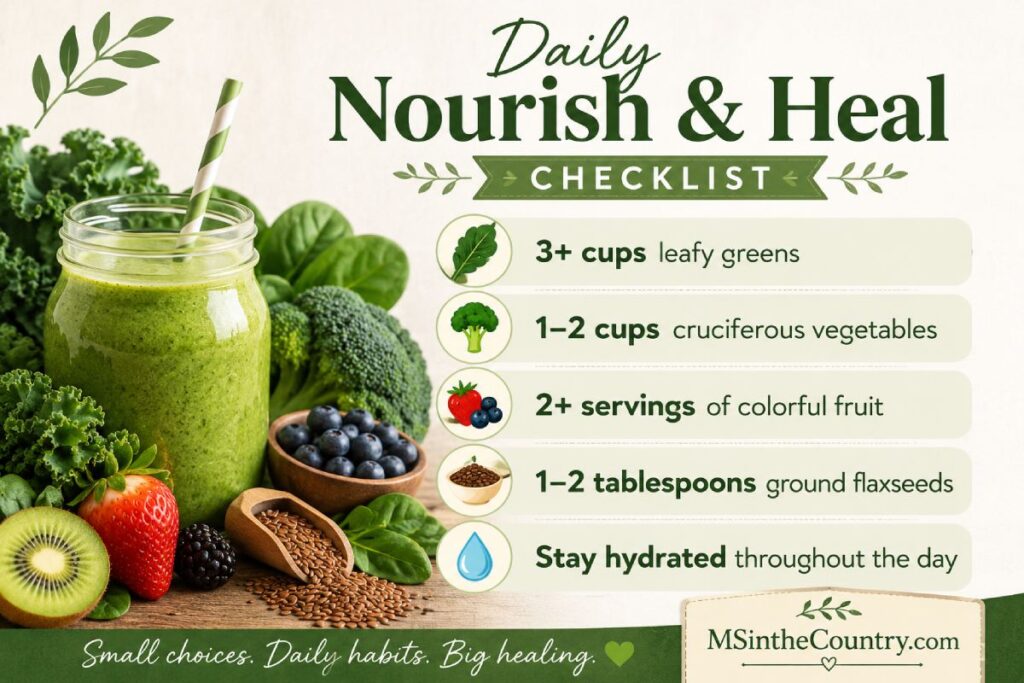
If changing your diet feels overwhelming, don’t try to do everything at once. Here’s a simple daily checklist to get started. 👇
🌿 Healing Tip:
Black pepper activates the curcumin in turmeric, making it significantly more bioavailable — a small detail that makes a real difference.
Practical Tips for Eating Well With MS
When people ask me what to eat with MS, I always start with the same answer: begin with foods you actually enjoy. If you’re standing at that refrigerator right now feeling overwhelmed, here are some things that have genuinely helped me over the years.
Use frozen vegetables. Fresh produce is wonderful, but it goes bad — and there’s nothing more discouraging than opening your refrigerator to find that the vegetables you bought have wilted in the back. Frozen vegetables are picked and frozen at peak nutrition; they’re always available, and they eliminate waste. I especially love frozen sweet potatoes and frozen butternut squash, because fresh versions are notoriously hard to cut. For anyone dealing with hand weakness — which is common with MS — this is a practical game-changer.
🌿 Healing Tip:
Frozen sweet potatoes and butternut squash are a practical solution if you have hand weakness — no wrestling with a hard-to-cut vegetable, and the nutrition is just as good as fresh.
Buy pre-steamed vegetables when you need to. Many stores now sell bags of pre-steamed vegetables that just need to be warmed up. All you need to do is add something on top — a squeeze of lemon juice, a drizzle of coconut aminos, a handful of sliced almonds or walnuts, some flaxseeds, chia seeds, or hemp seeds. Healthy eating does not have to mean cooking from scratch every single day.
Eat meat at lunch, not dinner. If you eat animal protein, consider shifting it to midday rather than the evening meal. Your body digests heavier proteins more efficiently earlier in the day, and a lighter dinner can improve your sleep and how you feel the next morning.
Add more to your smoothies than you think. Cauliflower rice, extra greens, flaxseeds, chia seeds — most of these disappear completely into a well-blended smoothie. The trick of blending your greens with water first before adding other ingredients really does help fit more in and ensures everything is properly broken down.
Start with vegetables you actually like. Healthy eating doesn’t mean forcing down foods you hate. If you love roasted sweet potatoes, make those. If you love cucumbers, eat more cucumbers. Building from a foundation of enjoyment makes sustainable change far more likely than following a restrictive protocol that makes you miserable.
Notice how food makes you feel. After you eat something, pay attention. Do you feel energized or sluggish? Does your digestion feel comfortable? Is there any skin reaction, brain fog, or unusual fatigue? Over time, those observations become your most valuable guide — more valuable than any book. It was this kind of attention that led me to discover my histamine sensitivity, and later, that my tolerance for those foods had changed.
🌿 Healing Tip:
If you’re eating a clean diet but still experiencing skin reactions, digestive issues, or unusual fatigue, look into high-histamine foods. Common “healthy” foods like sauerkraut, spinach, leftovers, and tomatoes can trigger reactions in some people with MS.
Give changes time. When I altered my diet and added certain supplements, it took about three months before I noticed the change in my heat intolerance. I had another symptom improve so slowly that it took me months to finally realize it too was gone. Real nutritional change takes time. Don’t expect results overnight, and don’t give up too quickly.
The Bottom Line on What to Eat With MS
After years of searching for the perfect answer to what to eat with MS, I found something better: a way of eating that is built around real food, personal awareness, and simplicity. No single protocol. No rigid rules. Just whole ingredients, a willingness to listen to my body, and a commitment to keep adjusting as needed.
Structured MS diets work wonderfully for many people, and if you’re thriving on one, that’s genuinely great. But if you’ve tried them and found yourself underweight, or dealing with unexpected reactions to “healthy” foods, or simply unable to sustain the restrictions long-term, know that there is another way. It requires more patience and self-observation than following a book, but it also gives you something no book can: a way of eating that is truly yours.
The meal I described above isn’t special or exotic. It’s just real food, made simply enough that I actually enjoy preparing it, adjusted over decades to fit what my specific body needs. And that sustainability — that livability — is exactly what makes it work.
If you’re newly navigating what to eat with MS, I hope this gives you something more useful than another list of foods to avoid. Start with what you have. Keep it simple. Pay attention. Adjust over time.
Your body already knows a lot. The goal is to start listening to it.
Have you found a way of eating that works for your MS? Have you experienced something unexpected — like a food sensitivity you never saw coming, or a symptom that improved after a dietary change? I’d love to hear your story in the comments below. And if this post helped you, please share it — you never know who might be standing at their refrigerator right now, wondering what to do next.
Want to dig deeper into how food may affect your symptoms? My Gut Dominant and Inflammation Dominant Healing Guides explore two areas that can help you better understand your individual MS pattern.