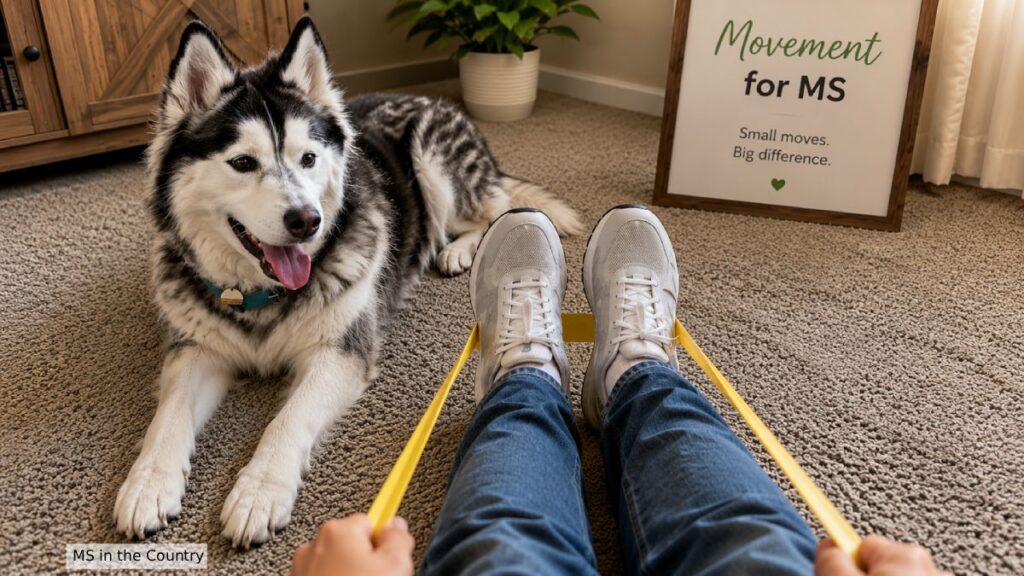
Movement for MS doesn’t always look like exercise. When I was younger, I was always moving — hiking, biking, skiing, backpacking, long walks just because. Exercise classes weren’t really my thing, but staying active was just part of life.
Now, living with MS and getting a bit older, movement looks completely different. Some days, just getting out of bed feels like a win. If you deal with foot drop, spasticity, stiff knees, leg weakness, or fatigue, you know that feeling of trudging through mud with every single step.
But here’s something that changed how I think about movement for MS: you don’t have to “exercise” to make a real difference. You just have to not be sedentary.
🌿 Healing Tip:
The goal of movement for MS isn’t perfection. The goal is to spend a little less time sedentary today than you did yesterday.
What Does “Sedentary” Actually Mean?
Every major health authority warns that a sedentary lifestyle is harmful. But for people with MS who struggle to walk, what does that really mean — and what’s realistic?
Researchers generally define sedentary as spending most of your day sitting or lying down, with very little movement beyond basic daily tasks. Here’s a simple breakdown:
- Sedentary: Mostly sitting, little intentional movement
- Lightly active: Frequent standing, walking around the house, short walks, movement breaks
- Moderately active: About 150 minutes per week of moderate activity (the standard guideline)
- Very active: More than that
Here’s the good news for movement and MS: the goal doesn’t have to be 150 minutes right away. What matters most is breaking up long stretches of sitting.
🌿 Healing Tip:
Consistency matters more than intensity. A few minutes of movement for MS repeated throughout the day can add up to meaningful activity by bedtime.
Why Small Movement Matters
When we sit for long periods, our muscles don’t get much of a signal to work. Blood flow slows down, joints become stiff, and it can become even harder to get moving again.
Many people with MS already deal with muscle weakness, balance challenges, fatigue, and spasticity. Spending hours without moving can make those symptoms feel even worse.
That’s why I like to think of movement as “telling your body you’re still using it.”
Every time you stand up, stretch, walk across the room, or move your legs while sitting, you’re reminding your muscles, joints, and nervous system to stay engaged. No single movement session has to be perfect. The benefits come from repeating those small movements throughout the day.
Over time, those little movement breaks can add up to:
- Less stiffness
- Better circulation
- Improved flexibility
- More confidence moving around
- Greater independence with daily activities
The goal isn’t perfection. The goal is simply moving a little more today than yesterday.
Movement Counts Even If You’re Sitting
One of the biggest misconceptions about movement for MS is that it only “counts” if you’re standing or walking.
That’s simply not true.
If you use a wheelchair, have balance problems, or are having a difficult symptom day, seated movement still matters.
You can:
- March your legs while seated
- Lift and lower your toes
- Do ankle circles
- Reach overhead and stretch
- Roll your shoulders
- Practice seated leg extensions
- Shift your weight from side to side
On some days, that may be all you can do. And that’s okay.
Movement isn’t an all-or-nothing activity. Every movement is information you’re sending to your body. Small movements still count.
🌿 Healing Tip:
On low-energy days, lower the goal instead of skipping movement altogether. Even one minute of movement for MS is better than staying completely still.
You Don’t Need to Get Out of Breath
When it comes to movement for MS, frequency may matter more than formal exercise sessions. Some research suggests that simply avoiding long periods of inactivity may be nearly as important as structured exercise itself. In fact, researchers are now studying whether reducing sedentary behaviour itself may help improve symptoms and quality of life for people with MS. You can read about the study from PubMed here.
A simple goal: move something every hour you’re awake.
That could look like:
- 10 ankle circles
- 10 leg lifts
- Standing for 30 seconds
- Walking to the kitchen and back
- Weight shifting while holding the counter
- Wall pushups
- 10–15 squats, holding onto something sturdy
- A few minutes of seated exercises after meals
Do that 8–10 times a day, and you’ve already moved from “sedentary” toward “lightly active” — without ever stepping into a gym.
How I Stay on Track
Honestly, the hardest part is remembering. When I’m home, I sometimes ask Alexa to set hourly alarms until a certain time each night, especially when I’ve been on my computer. It’s a simple nudge that keeps me from getting stiff and stuck in one position too long.
I also use a vibration plate to help get my blood flowing — a low-effort way to wake up tired legs. I bought a Lifepro Rumblex Plus from Amazon.
For more structured movement, I like OptimalBody Personal Fitness, an online gym built specifically for people with MS. It uses resistance bands and includes exercises for people in wheelchairs. What I appreciate most is that the owner, David Lyons, has MS himself — so the exercises come from real, lived experience, not just theory.

You may also enjoy reading…
Six new MS research discoveries bring hope for people living with MS.
Try the 7-Day Movement Challenge
Ready to put this into practice? Here’s a simple way to test it out for yourself.
For the next seven days, set a timer to go off once every hour while you’re awake.
When the alarm rings, spend just one or two minutes moving.
Don’t worry about how many calories you’re burning. Don’t worry about whether it qualifies as exercise.
Just move.
At the end of the week, ask yourself:
- Do I feel less stiff?
- Am I standing up a little easier?
- Do my legs feel more awake?
- Am I spending less time sitting?
You may be surprised by how much difference a few minutes of movement each hour can make.
What About You?
Think about your typical day. Roughly how many hours are you sitting in a recliner versus standing, walking, or doing chores? You might be surprised at the answer — and that number is a great starting point for adding small movement breaks.
The Bottom Line
Movement for MS isn’t about pushing through pain or hitting some intense workout goal. It’s about breaking up the sitting, moving a little every hour, and giving your body small, frequent signals that it’s still in motion. Small, consistent movement adds up — and it’s something almost anyone can start today, no matter how they feel.
• MS HEALING GUIDES
Finally, guides built
for how MS actually works.
Each guide tackles one real MS challenge (fatigue, nutrition, gut health, etc.) and gives you clear, research-backed steps you can start today. No fluff. No overwhelm.