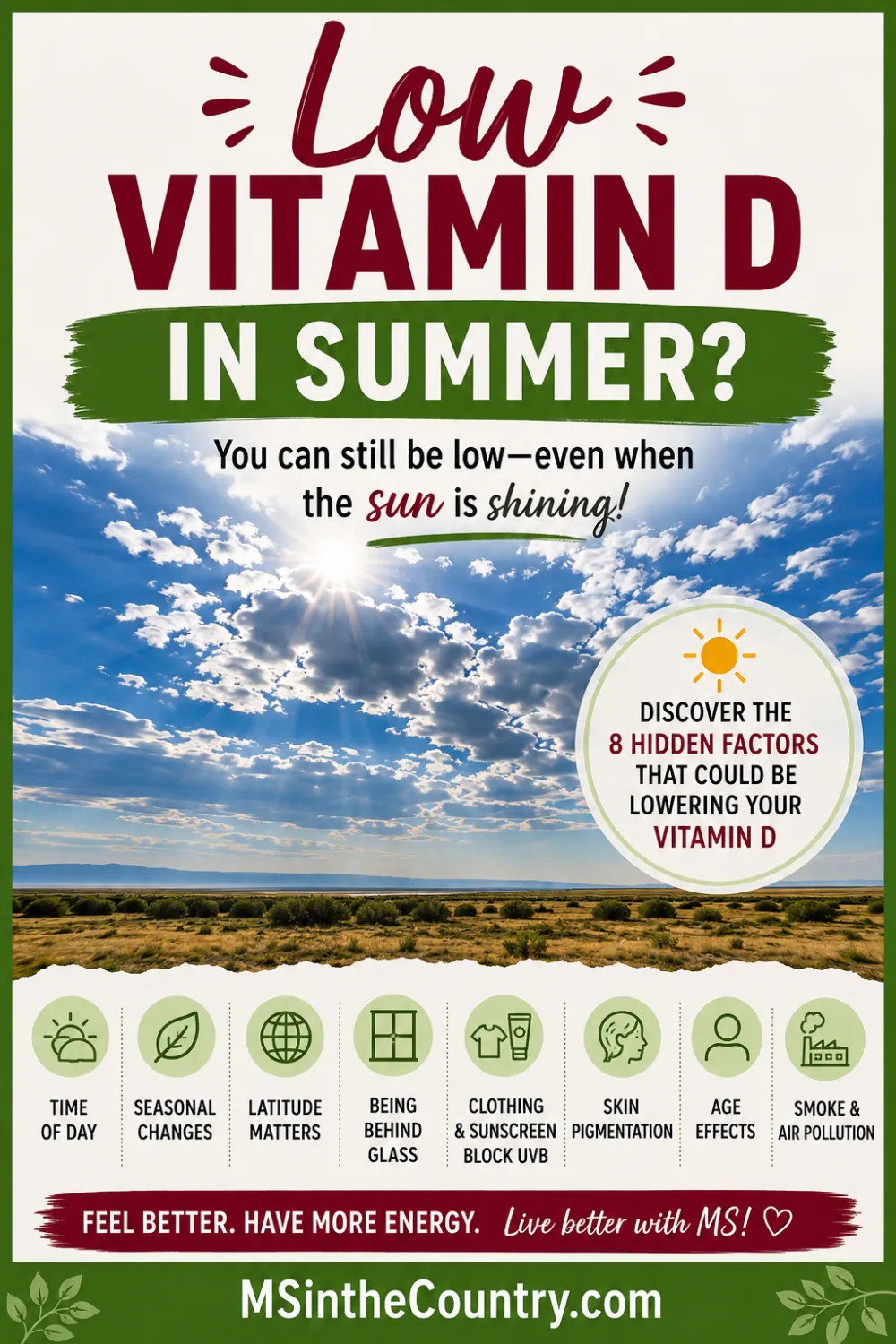
Can you really have low vitamin D in summer, when the days are long and the sun is shining? Surprisingly, several things can reduce how much vitamin D your body makes.
Living out here in the country, I get to see a lot of sky. There’s nothing blocking the horizon — no buildings, no trees crowding in — just miles of open land in every direction. One of the small pleasures of that view is watching the sun’s path shift through the seasons. Right now, if you pay attention, you can actually see it: the sun is rising and setting noticeably further south than it was even a few weeks ago.
That seasonal shift has also made me think more about vitamin D and MS, especially as summer begins winding down.
For most people, that’s just a pretty seasonal change. For those of us managing MS, it’s also a quiet signal worth paying attention to — because it usually means less sun on our skin, and less sun means less vitamin D.
But This August Wasn’t Actually a “Sunny Month” for Me
Here’s the thing that caught my attention this year. August is supposed to be one of our sunniest months. And yet there were days — plenty of them — where I couldn’t even see the sun. Wildfire smoke settled in so thick that the sky turned hazy and dim, sometimes for days at a stretch. On top of that, when the air quality was bad, I stayed inside anyway.
Heat intolerance and wildfire smoke are two reasons people with MS could end up with low vitamin D in summer, even when there seems to be plenty of sunshine.
So even in what’s “supposed to be” a high-sun month, my actual sun exposure was a lot lower than the calendar would suggest. And I have to imagine I’m not the only one in the MS community who experienced that this year. It made me realize how easy it could be to have low vitamin D in summer, even during a month we think of as sunny.
Why Vitamin D and MS Are So Closely Studied
Vitamin D isn’t just about bone health — it plays a role in regulating the immune system, and researchers have been studying its connection to MS for years.
Several studies have found a connection between lower vitamin D levels and more MS relapses. In one study, people who had frequent relapses also had lower vitamin D levels (source).
It’s worth being honest about the research here, the way I try to be with everything I share: the picture isn’t perfectly clean. While low vitamin D is consistently linked to higher relapse risk in observational studies, clinical trials testing whether vitamin D supplements actually prevent relapses haven’t shown the same clear benefit (source). Researchers think this might be due to differences in dosing, study length, or how “relapse” gets measured across studies.
And here’s another thing that’s important to remember: geography doesn’t tell the whole story. Although MS has historically been more common in populations living farther from the equator, researchers know that sunlight and vitamin D can’t fully explain who develops MS. Genetics, environment, infections, lifestyle, and other factors may all be part of the picture.
In other words, vitamin D matters, but it’s only one piece of a much bigger MS puzzle.
So the honest takeaway isn’t “take vitamin D, and you’re protected.” It’s more like this: lower vitamin D levels have been associated with greater MS disease activity, and making sure your level doesn’t quietly slide is worth paying attention to — especially heading into a season when several things can work against you at once.
What My Own Vitamin D Test Showed Me
Vitamin D became much more personal to me when I was trying to figure out what my body needed to function at its best.
At the time, heat intolerance was a major problem for me. Like many people with MS, hot weather could make everyday life much harder. I was already changing my diet and paying close attention to how different foods and lifestyle habits affected me, but I also decided to have my vitamin D level checked.
The result surprised me. My vitamin D wasn’t technically deficient. It was sitting near the bottom of what the lab considered the “normal” range.
That made me look at the number differently. Being within a laboratory reference range doesn’t necessarily tell you whether your level is ideal for you. I decided I didn’t want my vitamin D hovering near the bottom of the range, so I increased my vitamin D intake and continued monitoring my level.
Over time, something remarkable happened: my heat intolerance disappeared.
I can’t say that raising my vitamin D caused that change. I had changed several things during the same period, including my diet, so there is no way for me to separate one factor from another. That’s an important distinction. My experience is not proof that vitamin D reverses heat intolerance in MS.
But it did teach me something valuable. I don’t want to wait until something falls outside a laboratory reference range before I pay attention to it. Vitamin D became one more piece of the bigger picture I use to support my health.
And that’s one reason I still pay attention to it today.
Why You Can Have Low Vitamin D in Summer
There are so many things besides clouds that determine how much vitamin D your skin can make:
- Time of day: UVB is strongest when the sun is higher in the sky. Early morning and evening sunlight may feel wonderful, but it generally isn’t very effective for vitamin D production.
- Season: As fall approaches, the sun’s angle gets lower. At northern latitudes, winter sunlight may provide very little useful UVB for vitamin D production.
- Latitude: The farther you live from the equator, the more dramatically vitamin D-producing UVB changes with the seasons.
- Being behind glass: Sitting beside a sunny window doesn’t have the same effect because ordinary window glass blocks most UVB.
- Clothing and sunscreen: Both reduce the amount of UVB reaching your skin.
- Skin pigmentation: Melanin reduces UVB penetration, so people with darker skin generally need more UVB exposure to produce the same amount of vitamin D.
- Age: Our skin becomes less efficient at producing vitamin D as we get older.
- Smoke and air pollution: Heavy atmospheric pollution can reduce the UVB reaching ground level.
Three Things Quietly Cutting Into Your Sun Exposure Right Now
- The sun’s natural seasonal shift. As we move toward fall, the sun sits lower in the sky, and its path moves south. This happens every year, gradually, which makes it easy to not notice until you’re deep into the low-light months.
- Wildfire smoke. Smoke doesn’t just make the sky look hazy — it scatters and blocks UVB rays, the specific wavelength your skin needs to produce vitamin D. A smoky “sunny” day can leave you with a lot less usable sun exposure than it looks like from behind your window.
- Heat intolerance keeping you indoors. If heat is one of your MS triggers, you may already be avoiding peak sun hours during the hottest parts of summer — which, ironically, are also the months when sun exposure would normally be topping off your vitamin D stores for the year.
Any one of these on its own might not matter much. All three stacking up in the same season is worth noticing.
Can You Store Vitamin D From Summer?
Your body can store vitamin D, mainly in fat and muscle tissue. That’s one reason vitamin D levels can rise during sunnier months and then gradually decline during fall and winter.
But summer doesn’t necessarily guarantee that you built up large stores.
Think about your own August. There may have been plenty of daylight, but how much of it actually reached your bare skin? If you spent hot afternoons indoors, avoided being outside because of wildfire smoke, wore clothing that covered most of your skin, or simply weren’t outside very much, your vitamin D production may have been lower than you’d expect. That’s one reason low vitamin D in summer shouldn’t automatically be ruled out just because the weather has been sunny.
🌿 Healing Tip:
Don’t assume a sunny summer means your vitamin D level is where you want it. Heat, smoke, time indoors, clothing, and the changing angle of the sun can all reduce how much vitamin D your skin makes. And don’t assume you also have low vitamin D in summer. A blood test takes the guesswork out of knowing where you stand.
Why Late Summer Is a Good Time to Pay Attention
Most vitamin D conversations seem to happen in winter, once the low-light months have already settled in. By then, you’re not catching a seasonal dip — you may already be well into it. Winter days are shorter, the sun sits lower in the sky, and vitamin D levels may have been gradually declining for months.
Late August and September give you a chance to think about vitamin D before you’re deep into the darker months. There’s still time to take stock of how much sun you’ve actually been getting before the darker months arrive.
This can be a good time to have your vitamin D level checked rather than assuming summer sunshine has kept it where you want it. Depending on the results, you might spend a little more time outdoors when conditions allow, pay more attention to vitamin D-rich foods, or talk with your doctor about whether supplementation makes sense for you.
Think of it as the seasonal equivalent of checking your tire pressure before a road trip instead of after you’re already stranded. Nothing dramatic has to be wrong for it to be worth a look.
What You Can Do About It
You don’t need to guess about your vitamin D status. A 25-hydroxyvitamin D blood test can show you where your level actually stands.
From there, think about the everyday factors that may be affecting your vitamin D.
- Pay attention to how much sun you’re actually getting. A sunny forecast doesn’t necessarily mean you’ve spent meaningful time outdoors.
- Remember that timing matters. Early morning and evening sunlight may be cooler and more comfortable, but UVB levels are usually much lower then. The sun needs to be high enough in the sky for significant vitamin D production.
- Include vitamin D-rich foods when they work for you. Fatty fish such as salmon, sardines, trout, and mackerel are among the best natural food sources. Some mushrooms and fortified foods can provide additional vitamin D.
- Consider supplementation if you aren’t getting enough. The amount someone needs can vary considerably, which is another reason I prefer knowing my blood level instead of guessing.
- Recheck instead of assuming. If you make changes to raise your vitamin D, testing again later can tell you whether those changes actually worked.
I think of vitamin D as one piece of a much larger puzzle. Nutrition, movement, sleep, stress, time outdoors, and other everyday habits all matter. Instead of looking for one magic answer, I prefer to look at how those pieces work together.
☀️ WANT TO LEARN MORE ABOUT VITAMIN D?
My Vitamin D Healing Guide puts the important information in one easy-to-use place, including vitamin D-rich foods, sun exposure, testing, and supplement basics.
A Small Seasonal Habit Worth Building
When it comes to vitamin D and MS, I think the most important thing is not to assume your level is fine simply because you’ve had a sunny summer.
I don’t think you need to overhaul your life around this. But I’ve started treating that shifting sunset — watching where it drops on the horizon each week — as a little seasonal check-in. It reminds me to ask myself: have I actually gotten outside today, or has it just been a “sunny month” on paper?
Given everything working against sun exposure this year — smoke, heat, and the season naturally turning — it felt like a question worth asking a little earlier than usual.
That’s why I don’t think we should assume low vitamin D in summer isn’t possible. What matters isn’t how many sunny days were on the calendar, but how much useful sun exposure we actually received.
Keep Going: Build Your MS Healing Plan
Low vitamin D in summer may be one piece of the puzzle, but nutrition, gut health, stress, sleep, movement, and supporting your nervous system can all be part of the bigger picture.
If you’re ready to keep going, here are a few places to start:
→ Nourish and Heal: 5 Steps to Healing Naturally
Start here if you want to see how food, lifestyle, and everyday habits can work together.
→ What Causes MS Fatigue?
If low energy has been getting in your way, learn about some of the different things that may contribute to MS fatigue.
→ Nervous System Healing Guide
Learn simple ways to support a calmer nervous system and reduce some of the everyday stress your body is carrying.
→ Explore All My MS Healing Guides
Choose the area you’d like to work on next, from gut health and energy to vitamin D, B12, inflammation, and nervous system support.
💌 Small shifts can lead to big changes.
Join my MS in the Country newsletter for gentle reminders, healing tips, and encouragement to stay hydrated and take care of your body — one simple step at a time.
🌿 Ready to Put It All Together?
Better Days: A 90-Day Quality of Life Workbook helps you turn what you’re learning into small, realistic daily steps. Use it to track your habits, notice patterns, celebrate progress, and discover what helps you feel your best.
→ Take a Look at Better Days
📌 Low Vitamin D in Summer? Save This for Later
Save this pin for later! The Pinterest button is just below this image. 👇