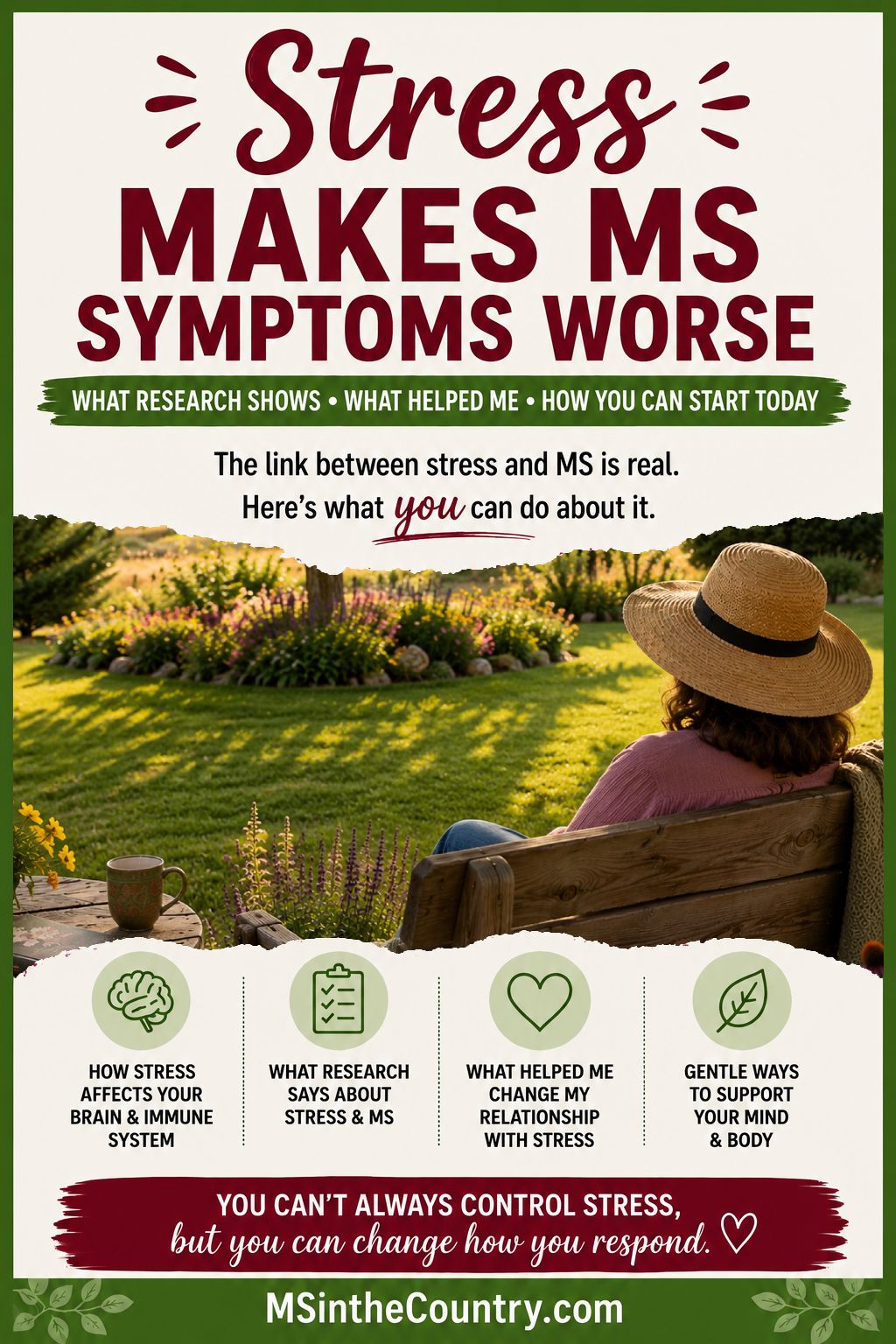
Stress makes MS symptoms worse — I know that firsthand, because I’ve struggled with stress for as long as I can remember, long before MS ever entered the picture.
As a young child, I experienced situations at home that left me feeling scared and uncertain. I didn’t understand it at the time, but my body learned to stay on high alert. Even when life was calm, I was always waiting for the next bad thing to happen. As an adult, I reacted to everyday problems as if they were emergencies, because that’s what my brain had learned to do.
It took me many years to realize I wasn’t just reacting to what was happening today. I was reacting with habits I’d learned decades earlier.
In this article, I’ll explain why stress makes MS symptoms worse according to research, share my own experience, and walk through three changes that helped me respond differently.
What Changed, and What Didn’t
A few years ago, one unexpected problem could have ruined my entire day. My heart would race. My mind would jump to worst-case scenarios. I’d replay the mistake over and over, trying to figure out how to fix it.
Recently, something happened that easily could have triggered that same response. For a split second, I felt the familiar wave of panic. Then I stopped.
I reminded myself that worrying wouldn’t solve the problem. We’d deal with it one step at a time. Instead of spending the day stressed, I accepted what had happened and focused on the next thing I could do.
The situation worked itself out, but the biggest victory wasn’t the outcome. It was realizing how much my response had changed.
Why Stress Makes MS Symptoms Worse
I’m far from the only one who’s noticed this connection. Researchers have been studying the link between stress and MS for decades, and a large body of research now points in the same direction: psychological stress is tied to a higher risk of relapse and, over time, disability progression. One recent systematic review pulled together data from over 30 studies and found this connection held up across nearly 25,000 cases.
Part of “why” makes sense once you understand what chronic stress does to the body. Long-term stress disrupts the system that regulates your stress hormones, and that disruption can leave the body in a low-grade, ongoing state of inflammation. For a condition like MS, where inflammation already plays a central role, that’s not a small thing. This helps explain why stress makes MS symptoms worse for many people living with MS.
There’s also research suggesting the effects of stress can run even deeper and further back than people realize. A study out of Duke University found that childhood stress was linked to worse pain, fatigue, and mental health in adults living with MS, decades later. Reading that research was the first time I saw my own experience reflected back at me in black and white — the idea that what happened to me as a small child could still be shaping how my body responds to stress today.
🌿 Healing Tip:
The next time you feel stress spiraling, try this: pause, take one slow breath, and say a short phrase out loud or in your head — something like “We’ll figure this out.” It sounds small, but interrupting the spiral with words, even simple ones, gives your mind something else to hold onto besides the worry.
My Turning Point: Why Stress Makes MS Symptoms Worse for Me
For me, I noticed that whenever I became highly stressed, my symptoms got worse. I also believe — though I can’t prove exactly how much each factor contributed — that years of chronic stress played a real role in my walking getting worse.
During the Great Recession, life became incredibly stressful. My husband’s job disappeared, and my own workplace was filled with uncertainty. Every few months, people were laid off, wages were cut, hours were reduced, and everyone wondered if they’d be next.
At the same time, my job changed. I lost the position that had me walking throughout the building every day and instead spent most of my day sitting at a desk. My legs became stiffer, and I noticed I was falling more often.
Then I had a serious fall at work that resulted in surgery. When I returned, I was worried about losing my job. Looking back, I believe those years created a perfect storm — chronic stress, less movement, and injury, all stacked on top of each other. I can’t prove exactly how much each one contributed, but I believe prolonged stress was one of the reasons my walking became more difficult.
3 Things That Helped Me When Stress Makes MS Symptoms Worse
1. I started paying attention to people who seemed calm and content. They still had problems — everyone does — but they didn’t seem to carry every worry around with them the way I did. I realized I wanted that kind of peace too, and that it might actually be possible for me.
2. I stopped ignoring the mind-body connection. I knew chronic stress could affect the entire body. If I wanted to give myself the best chance to feel better, I couldn’t keep ignoring the way I reacted to life’s challenges.
3. I changed how I talked to myself. This was the biggest shift, and the hardest one. I started actually listening to the way I talked to myself, and honestly, I wasn’t very kind. I expected the worst. I criticized myself. I blamed myself for things that weren’t my fault. I treated myself in ways I would never treat someone I loved.
So I decided to change that. Every time I caught myself spiraling into worry or talking negatively to myself, I paused. Instead of assuming the worst, I’d remind myself, “We’ll figure this out.” Instead of criticizing my body, I’d remind myself it was doing the best it could. Instead of replaying fearful thoughts over and over, I’d redirect my mind to what I could actually do in that moment.
At first, it felt awkward. I’d been thinking the same way for decades, and changing that habit didn’t happen overnight. But little by little, those new thoughts became more natural.
🌿 Want to help your nervous system feel calmer?
Stress can keep your nervous system stuck in a heightened state. My Nervous System Healing Guide walks you through simple ways to support a calmer nervous system and build more resilience to everyday stress. Learn more →
Where I Am Now
Today, I still have stressful moments. The difference is that I don’t stay there. My mind is quieter. I’m more patient. I sleep better. And I no longer spend so much energy worrying about things that may never happen.
Changing how I responded to stress didn’t change my past. But it did change the way I experience today.
If you’ve noticed that stress makes MS symptoms worse, know that this kind of change is possible — even if, like me, you’ve been carrying it since long before your diagnosis. It’s slow, and it’s not really about willpower. It’s about noticing, and choosing something different, one moment at a time.
If you’re working on this too, a few things that pair well with this kind of inner work: staying as active as your body allows (I write more about that in Keep Moving), supporting your gut, since stress and gut health are more connected than most people realize (Gut Health & MS), and tracking your own patterns over time, which is exactly what the trigger-tracking section of Better Days was built for.
And if heat is also a trigger for you, know that stress and heat often compound each other — I wrote more about that connection in Why Heat Makes MS Symptoms Worse.
🧩 Still Trying to Figure Out Your MS Symptoms?
Download my free Find Your Root Cause of MS guide to discover which healing pattern best matches your symptoms. You’ll also be subscribed to my free weekly MS in the Country newsletter, where I share whole-food recipes, practical MS tips, and new articles to help you live better with MS. Sign up below 👇
📌 Does Stress Make MS Symptoms Worse?
Save this pin for later! The Pinterest button is just below this image. 👇