
I used to dread summer.
Not because I don’t love the sunshine — I do. But for years, heat and I were not friends. If I got too warm, my whole body would shut down. Not “feeling tired” shut down — I mean hours of recovery before I felt like myself again. I’d plan my entire day around avoiding it: staying inside, staying still, dreading anything that might tip me over that invisible line.
If you have MS, you probably know exactly what I’m talking about — and you’re probably looking for real cooling foods for MS, not just a list of anything cold.
Here’s the part that still amazes me, even years later: it’s not like that anymore. On 100° days, I can be outside. I still like to cool down — who doesn’t — but my body doesn’t shut down the way it used to. And the biggest shift didn’t come from air conditioning or ice packs. It came from changing what I ate.
Why Heat Hits So Hard When You Have MS
If you’ve ever had your vision blur, your legs get heavy, or your brain fog rolls in on a hot day — and then watched it all improve once you cooled off — you’ve experienced something called Uhthoff’s phenomenon. It’s a well-documented, temporary worsening of MS symptoms triggered by a rise in body temperature, first described by a German ophthalmologist back in 1890, and it’s still one of the most common experiences reported by people with MS today.1,2
Here’s what’s actually happening: heat slows the conduction of nerve signals along damaged, demyelinated nerve fibers. That slowdown is what produces the blurry vision, fatigue, weakness, or brain fog so many of us know well. The reassuring part is that it’s temporary — no new damage happens, and symptoms typically resolve once your body cools back down.2,3
For me, there was a second piece to the puzzle: histamine. In 2015, after years of following one strict “MS diet” after another, I finally stopped trying to follow someone else’s rulebook and started paying attention to what my body was actually telling me. I noticed a pattern — high-histamine foods (hello, barbecue) were causing my face to break out in a rash. That meant cutting back on foods I’d always thought of as “healthy,” including sauerkraut. It was a good reminder that just because something is healthy in general doesn’t mean it’s healthy for you — our bodies are individual, and paying attention to your own reactions matters more than following a rule written for someone else.4
I also had my vitamin D checked — it was on the low end of “normal” — and started supplementing under the guidance of my functional medicine provider. That mattered more than I expected. People with MS are more prone to low vitamin D in part because heat sensitivity keeps many of us out of the sun, and vitamin D itself plays an important role in the immune system and in MS itself.2 (If you want to dig deeper into this, I put together a Vitamin D Healthy Guide that walks through what to know and ask your provider.)
And then there was stress. Not just lowering it, but changing how I reacted to it and how I talked to myself. Deep breathing, meditation, and time in nature (easy for me — I just have to step out my door) became part of my daily rhythm. Stress hormones can themselves make the body more sensitive to heat, so calming my nervous system turned out to be part of calming my heat response too.5
Three months later, in June 2015, summer arrived — and my heat intolerance didn’t. I tested it over and over that summer, half-convinced I’d imagine it. I hadn’t.
I’m not a doctor, and this isn’t medical advice — just what worked for my body. But if heat has been controlling your summer, it might be worth looking at your own diet and stress patterns, not just your thermostat.
My Favorite Cooling Foods for MS
None of this means giving up warm-weather favorites. It just means being a little intentional. A few principles guide the cooling foods for MS that I reach for once the temperature climbs:
- Hydration-rich foods — not just water, but foods with high water content that help cool you from the inside.
- Steady blood sugar — a sugar spike-and-crash can mimic or worsen fatigue, which is the last thing you need on a hot day.
- Anti-inflammatory over inflammatory — leaning toward foods like tart cherries and berries instead of the sugar- and additive-heavy treats summer tempts us with.
- No stove required — light meals and no-cook snacks so I’m not standing over a hot burner adding heat to an already hot day.
Here are the cooling foods for MS in my regular summer rotation.
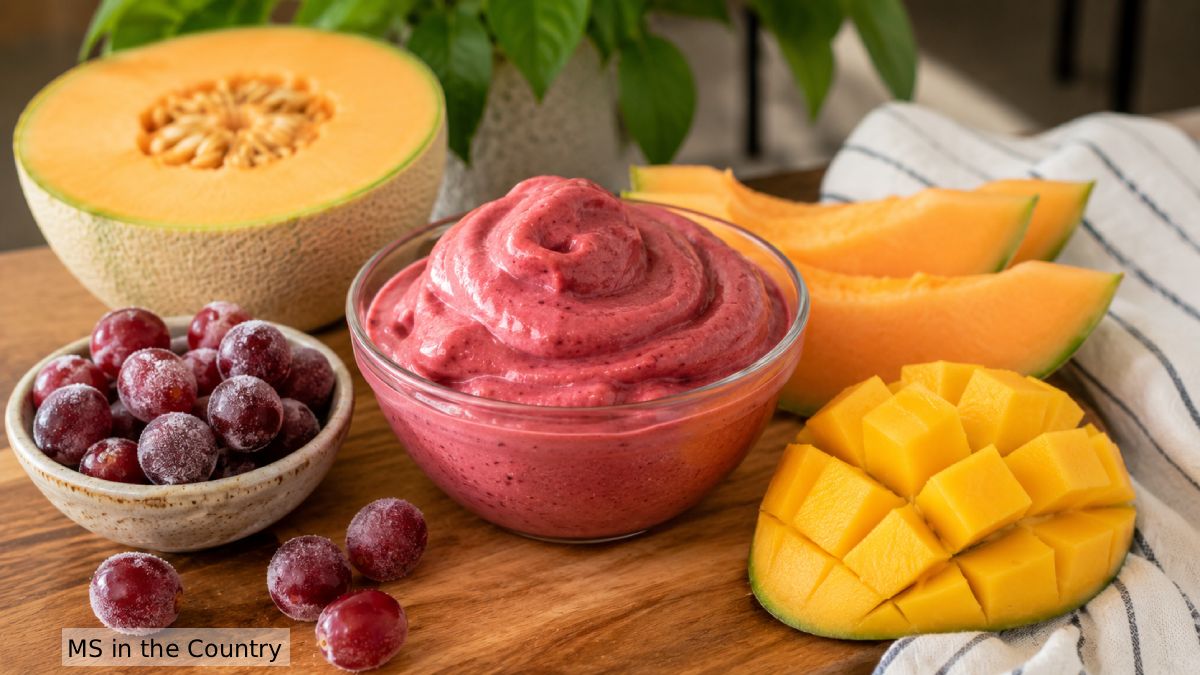
🍇 Frozen Grapes
The simplest thing on this list, and one of my favorites. Wash a bag of grapes, freeze them in a single layer, and you’ve got a naturally sweet, genuinely refreshing snack that takes zero effort — perfect for the low-energy days heat can bring. Grapes are mostly water, making them a hydrating, no-fuss way to cool down without turning on a single appliance. You can find my recipe here.
🍈 Melon
Melon is one of my favorite cooling foods for MS — watermelon, cantaloupe, honeydew, whatever’s ripe and ready. It’s mostly water, needs zero prep beyond slicing, and is genuinely refreshing on the hottest days. It’s an easy one to keep cut up and ready in the fridge for whenever you need a cool bite without any effort.
🌿 Healing Tip:
Watermelon is about 92% water and also has potassium, a mineral your body loses through sweat on hot days.10 That makes it a simple, sweet way to help replace fluids without reaching for anything processed.
🥭 Mango Smoothies
I love mangoes, so it’s no surprise I have two smoothies in regular rotation: my MS-Friendly Mango Smoothie and my Mango Almond Butter Smoothie (coming soon!). Both come together in minutes, sitting down, no stove involved — just blend and go. Smoothies are one of the easiest ways to pack in hydration and nutrients on days when standing at a counter chopping feels like too much.
🌿 Healing Tip:
Mangoes are naturally hydrating and rich in vitamin C, which supports the immune system. Blending in almond milk (I make my own or use Califia Farms) keeps these dairy-free and gentle.
🍒 Cherry Nice Cream
My favorite flavor, hands down — I’d eat it constantly if I let myself. Frozen bananas blended with tart cherries make one of the tastiest cooling foods for MS I know: a naturally sweet, dairy-free “nice cream” that feels indulgent but is doing real work behind the scenes. You can find my recipe here.
🌿 Healing Tip:
Tart cherries are rich in anthocyanins and other polyphenols with well-documented antioxidant and anti-inflammatory properties, and research links tart cherry intake to reduced inflammatory markers in the body.6,7 For those of us managing MS, leaning into anti-inflammatory foods whenever we can is one small, tasty way to support our bodies.
A Note on Flaxseed and Omega-3s
Flaxseed isn’t as instantly refreshing as frozen grapes or nice cream, but it earns its place on any list of cooling foods for MS because of what it does for inflammation year-round. Since we’re talking about foods that help with heat and inflammation, I can’t leave out ground flaxseed, which became a daily habit for me back in 2015 and still is.
Flaxseed is one of the richest plant sources of ALA, a plant-based omega-3 fatty acid. Research — including a large international study of people with MS — has linked regular flaxseed oil intake to significantly fewer relapses, and ALA is thought to help calm inflammatory processes and support the maintenance of myelin, the very thing MS attacks.8,9 I add a tablespoon of ground flaxseed to my smoothies most mornings — you’ll barely notice it’s there.
FAQ: MS and Heat Sensitivity
Does heat actually make MS worse? Heat doesn’t cause new nerve damage, but it can temporarily worsen existing MS symptoms like fatigue, brain fog, vision changes, and weakness — a response called Uhthoff’s phenomenon. Symptoms typically improve once your body cools back down.2,3
What are the best cooling foods for MS? There’s no single “cure-all” food, but hydrating foods (like grapes, melon, and smoothies), anti-inflammatory foods (like tart cherries), and steady, non-spiking meals can support your body’s ability to handle warmer temperatures. Identifying your own personal triggers matters just as much as adding in the good stuff — for me, that meant noticing that certain “healthy” high-histamine foods weren’t actually healthy for my body.
Can diet really change heat intolerance with MS? I can only speak from my own experience, but after changing my diet, addressing a low vitamin D level, and working on stress management, my severe heat intolerance resolved within a few months and hasn’t returned in years. That’s one story, not a clinical guarantee — but it’s why I’m such a believer in paying attention to your own body’s patterns.
Are frozen grapes good for MS? Frozen grapes aren’t a “treatment,” but they’re a hydrating, no-cook, easy-to-make snack that’s genuinely refreshing on hot days — helpful when heat and fatigue make more involved food prep feel impossible.
Whatever you reach for this summer, I hope you’ll try building a few of these cooling foods for MS into your own routine. Small changes added up for me over time, and they might do the same for you.
Sources:
- Uhthoff Phenomenon — StatPearls, NCBI Bookshelf, NIH
- Heat Intolerance in Multiple Sclerosis — News-Medical
- Uhthoff’s Phenomenon 125 Years Later — PMC/NCBI
- Can Hot Weather Trigger Histamine Sensitivity and MCAS? — Nutritionist Resource
- Heat Intolerance, Cold Intolerance & Histamine — Fact vs Fitness
- Effects of Tart Cherry and Its Metabolites on Aging and Inflammatory Conditions — PubMed
- Exploring the Epigenetic and Metabolic Pathways for Antioxidant and Anti-Inflammatory Potentials of Tart Cherry Juice Concentrate — PMC/NCBI
- Essential Fatty Acid Supplements — Overcoming MS (HOLISM study)
- Plant-Based Omega-3s May Reduce MS Risk — HealthCentral, citing Harvard research
- Watermelon: Health Benefits, Nutrition, and Risks — Medical News Today