

Every spring, as the temperatures start to climb, I used to feel a familiar dread creeping in. Not because I disliked warm weather, but because warm weather meant my body was about to turn against me.
For nearly 20 years, MS heat sensitivity (or heat intolerance) controlled my life. Anything over 70°F would cause my body to shut down. My vision would black out. My legs would go so weak I couldn’t walk. It could take hours to recover. I hid all summer indoors. I skipped outdoor parties. I remember being in the heat once, so miserable and so exhausted by a life I couldn’t fully live, that I just broke down and cried.
The Day That Still Stays With Me
There are a lot of hard memories from those years, but with my heat intolerance, this one stands out above all the rest.
It was 113°F outside. Our car’s air conditioning had stopped working, and I didn’t know it until I picked up my kids and we started the long drive home. We live in a rural area — there’s no quick detour, no nearby place to stop and cool down. Just road, heat, and distance.
With the windows down, I could feel it starting almost immediately. That unmistakable heaviness. The warning signal my body had learned to send. My MS heat sensitivity was kicking in, and I was behind the wheel with my children in the car.
I kept thinking: Please. Just let us get home safely.
It felt like that moment in Poltergeist where the hallway keeps stretching longer and longer no matter how far you walk — except this was real, and I was responsible for two kids who had no idea what was happening to their mom. It was getting harder to lift my leg to press the brake pedal. My vision was starting to fade at the edges.
This was before cell phones were something everyone carried. There was no one to call. No way to ask for help.
I had about 15 more minutes of driving ahead of me.
I made a decision in that moment: stay calm, stay focused, don’t let the kids see the fear. The road was quiet, thankfully. I kept driving. I don’t know how to fully explain what it takes to keep going when your body is begging you to stop — but any of you reading this who have experienced MS heat sensitivity probably understand it in a way most people never will.
We made it home.
I told the kids to go find their dad. I didn’t want them to see me struggle to get out of the car. I sat there for a moment alone, relieved and exhausted and shaking. My husband came out and helped me inside. The cool air of the house hit me like a wave of mercy. I lay down on the bed, and I cried — not just from relief, but from the grief of it. The anger of it. Hating what MS was doing to me and to my family, to the ordinary act of picking up my kids and driving home.
It took hours to recover.
That evening, my husband fixed the air conditioning. He didn’t make a big deal of it. He just fixed it. Sometimes love looks like that.
I share this story not to frighten anyone, but because I want you to know that I understand what MS heat sensitivity actually means in real life. It is not just feeling warm and uncomfortable. It can be dangerous. It can be terrifying. And it can happen on an ordinary day when you’re just trying to get your kids home.
You deserve real answers — not just “stay cool and drink water.”
If you have MS and heat sensitivity, you know exactly what I’m talking about.
What I want to share with you today is what happened when I stopped just coping with MS heat sensitivity — and started addressing the root causes that were making it worse.
🌿 Healing Tip:
Your body was doing its best to protect you. Healing begins when you start doing the same.
What Is MS Heat Sensitivity (and Why Does It Happen)?
MS heat sensitivity, also called Uhthoff’s Phenomenon, occurs because damaged myelin — the protective coating around your nerve fibers — makes those nerves extremely sensitive to even small rises in body temperature. When your core temperature rises, nerve signals slow down or stop entirely. The result can be sudden vision changes, overwhelming fatigue, weakness, and the inability to walk or function until your body cools back down.
It is one of the most debilitating and isolating parts of living with MS during warmer months.
Here’s something that took me a long time to understand: MS heat sensitivity isn’t just about temperature. It’s about the overall state of your nervous system. How well your damaged nerves are conducting signals. How much inflammation is your body carrying? Whether you’re hydrated, rested, and not running on a stress tank that’s been empty for months. When people with MS start addressing those underlying factors — really addressing them, not just dabbling — many find that their heat tolerance improves over time in ways that genuinely surprise them. I know because I was genuinely surprised.
My Story: What Changed Everything
In 2015, I made some significant changes to how I was managing my MS — changes I made after years of following strict MS diets.
Something just clicked that made me alter my diet to fit my needs. I added targeted supplements, including vitamin D and B vitamins, and omega-3s.
A 25-hydroxy vitamin D blood test revealed I was at 30.5 ng/mL — a level most doctors would call “normal,” but one that research increasingly suggests is far too low for people with MS. (I’ve written a guide on exactly this topic — Vitamin D and MS: Why “Normal” Isn’t Good Enough — which you can find HERE for $3.99. It covers why your vitamin D level might be quietly hurting you even when your doctor says you’re fine, and how to address it.)
But the change that surprised me most wasn’t dietary. It was the work I did on stress.
I didn’t just try to manage everyday stress. I went deeper than that. I worked on how I react to stress — the automatic patterns, the inner voice, the way I spoke to myself in difficult moments. I remember realizing: if I talked to a friend the way I talked to myself, we wouldn’t be friends for long. That shift — learning to treat myself with the same kindness I’d offer someone I loved — turned out to be one of the most powerful things I have ever done for my health.
Three months after making these changes, something extraordinary happened. We were on our way to the veterinarian with the dog in the picture above after he got cheatgrass stuck between his toes.
It was the first hot day of the season, but for the first time in years, my body wasn’t shutting down. My MS heat sensitivity was gone.
At first, I didn’t trust it. I tested it again and again, yet my body still wasn’t shutting down. I was just… outside. In the heat. Like a normal person.
I was so excited.
Eleven years later, my heat sensitivity has not come back. Eleven summers. I’ve been to outdoor parties. I’ve gardened. I’ve enjoyed mornings on the porch and afternoons in the yard. Things that were completely stolen from me for two decades.
Today I still eat an anti-inflammatory diet, exercise regularly, spend time in nature, and actively work on my stress. These aren’t things I do occasionally — they are the foundation of how I manage my MS.
🌿 Healing Tip:
The way you speak to yourself is either medicine or poison. Choose your words like your health depends on it — because it does
7 Natural Strategies for MS Heat Sensitivity This Summer
Whether you’re just starting to address heat sensitivity or looking to build on what you’re already doing, here are the strategies that have made the biggest difference — for me and for many others in the MS community.
1. Get Your Vitamin D Levels Tested — and Aim Higher Than “Normal”
Vitamin D deficiency is extremely common in people with MS and is strongly linked to immune dysregulation and inflammation. The standard lab reference range was not designed with MS in mind. Ask your doctor for a 25-hydroxy vitamin D test and discuss what an optimal level looks like for someone managing an autoimmune condition. My guide, Vitamin D and MS: Why “Normal” Isn’t Good Enough, goes into detail on this.
2. Adopt an Anti-Inflammatory Diet
What you eat directly affects the level of systemic inflammation in your body — and inflammation makes every MS symptom, including heat sensitivity, worse. Focus on whole foods, healthy fats (especially omega-3s), plenty of vegetables, and minimize processed foods, refined sugar, and alcohol. The right dietary approach is personal and may take time to dial in, but the payoff is significant.
3. Work on Stress — at a Deeper Level
Stress doesn’t just wear you out emotionally. It triggers inflammatory responses in the body that can amplify MS symptoms. But surface-level stress management (bubble baths and breathing exercises) will only get you so far. The deeper work is examining how you respond to stress, how you talk to yourself, and whether your inner dialogue is helping or hurting you. This kind of work changed my life more than any other single change I made.
4. Apply for the MSAA Free Cooling Vest Program
While you’re working on the longer-term natural strategies, don’t overlook this practical and free resource. The Multiple Sclerosis Association of America (MSAA) offers a Cooling Distribution Program that provides cooling vests and accessories to people with MS at no charge (income guidelines apply). Cooling vests contain insulated pockets that hold ice packs and have been shown in clinical research to meaningfully improve walking ability and reduce heat-related symptom flares. You can apply online or by mail:
MSAA Cooling Distribution Program Website: mymsaa.org/msaa-help/cooling-products/
The strongest current evidence still points to:
- Regular physical activity is paced to avoid overheating.
- Pre-cooling or cooling garments.
- A high-quality diet and other healthy habits.
- Sleep, mood, and stress management.
5. Time Your Activity Strategically
During warmer months, schedule outdoor activities and exercise for early morning or evening when temperatures are lowest. Even a few degrees of difference in surrounding temperature can determine whether your body handles the activity or shuts down. This isn’t giving in to MS heat sensitivity — it’s working within your current reality while you address the underlying drivers.
6. Prioritize Sleep and Recovery
Sleep is when your body does its most important repair work. Poor or insufficient sleep increases inflammation, worsens fatigue, and makes you more vulnerable to heat-triggered symptoms. Cool your sleeping environment, maintain a consistent schedule, and treat sleep as a non-negotiable part of your MS management — not a luxury.
7. Spend Time in Nature
This one often gets overlooked in clinical conversations, but time in nature — even gentle walks in shaded, cooler settings — has measurable effects on stress hormones, inflammation markers, and mood. For those of us managing MS, the mental and physical benefits of getting outside (even when it takes planning) are real. Find the shaded trail, the breezy morning, the garden in the early hours. Nature is medicine.
🌿 Healing Tip:
MS heat sensitivity thrives on inflammation, stress, and neglect. Starve it.
You Don’t Have to White-Knuckle Every Summer
MS heat sensitivity is real, it is serious, and it deserves to be taken seriously. But it is not necessarily permanent, and it is not beyond your influence. The body has a remarkable capacity to respond when we give it what it needs and remove what is harming it.
I spent 20 summers hiding. Now I spend them outside.
If you’re in the middle of dreading this season, I want you to know: it can get better. Sometimes dramatically, surprisingly better.
Start where you can. Get your vitamin D tested. Look at what you’re eating. Be honest about how you’re treating yourself when no one is watching. Apply for that cooling vest. One step at a time.
Your summers are worth fighting for.
Have you found anything that helps with MS heat sensitivity? Share in the comments below — your experience might be exactly what someone else needs to read today.
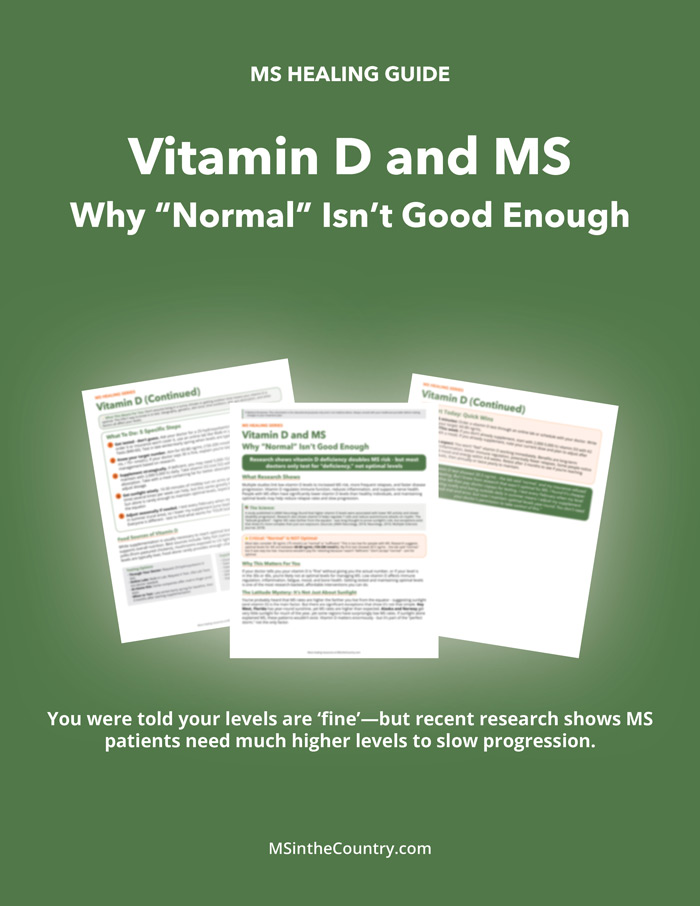
Vitamin D and MS: Why “Normal” May Not Be Enough
Learn what current research says about vitamin D levels, fatigue, immune health, and feeling your best with MS.