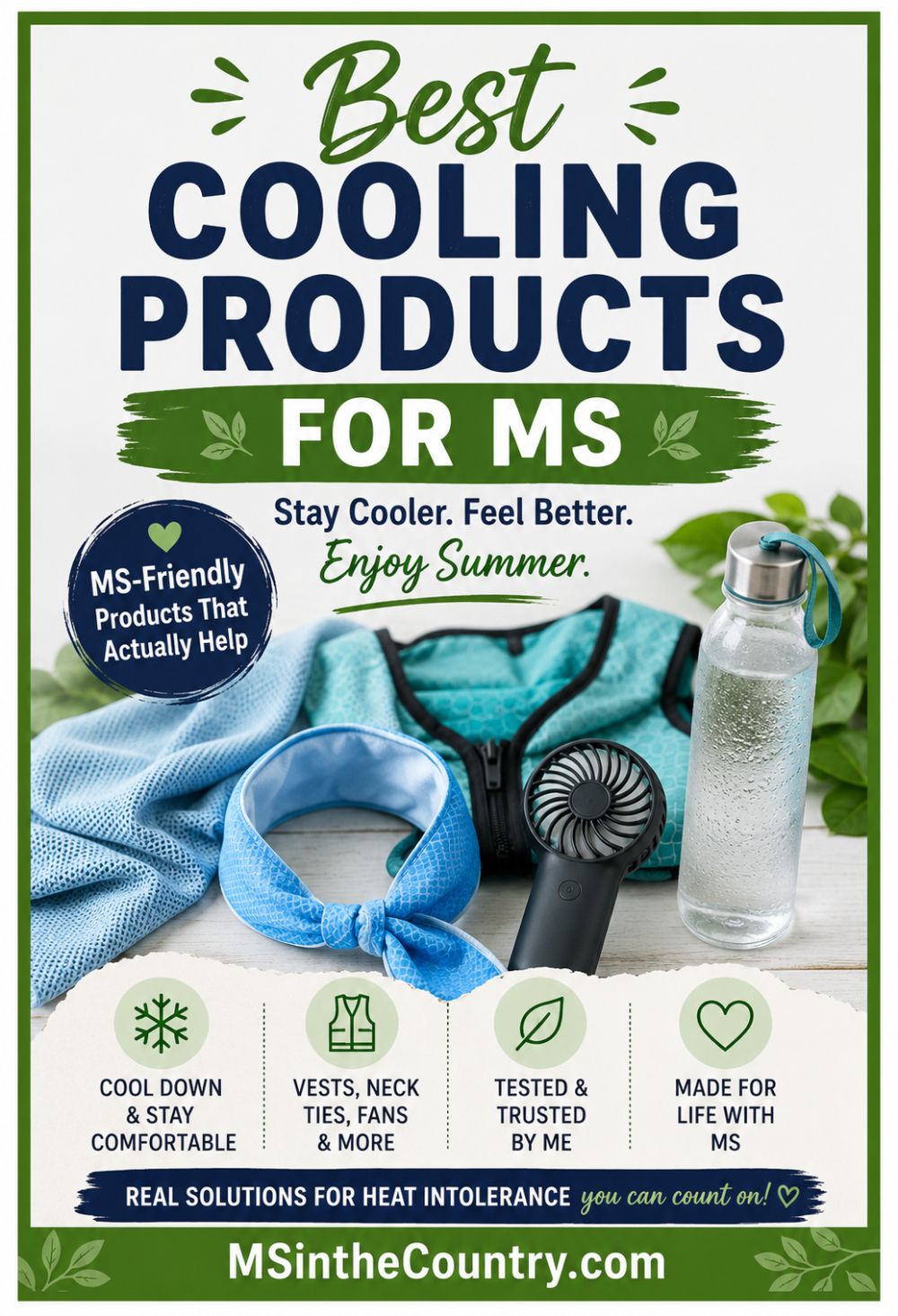
The best cooling products for MS can make a big difference when heat starts to worsen your symptoms. From cooling vests to neck wraps and fans, these products can help you stay more comfortable and enjoy summer with greater confidence.
For years, summer meant staying inside. I live out here on 40 acres, surrounded by everything I love — my garden, the mountains, the animals — and I’d watch it all from behind a window because stepping outside on a hot day felt like my body was shutting down.
That was heat intolerance, and if you have MS, you probably know exactly what I mean.
Here’s the part I still find amazing before we get into the products: my heat intolerance is gone now. I can be outside on a 100-degree day and be just fine. I can’t pinpoint one thing that I did to improve it, and I’m not saying that’s everyone’s story — MS is different for all of us. But I spent enough summers hiding indoors that I don’t take a single hot afternoon outside for granted anymore.
🌿 What changed for me went beyond cooling products. I eventually started looking at the bigger picture — including food, vitamin D, stress, and supporting my nervous system. I’ve put what I learned into my healing guides if you’re ready to start looking beyond symptom management.
Back when heat intolerance was part of my daily reality, three things made it possible for me to still get outside at all: cooling neck ties, a personal fan, and a misting fan. If you’re dealing with heat sensitivity right now, I want to walk you through what actually helped me — not just a list I found online, but what I reached for, year after year, before things changed for me.
Why Heat Hits MS Bodies So Differently
One of the reasons the best cooling products for MS can be so helpful is that many people experience Uhthoff’s phenomenon. This temporary worsening of symptoms happens when your body temperature rises, making it harder for damaged nerves to send signals efficiently. To learn more about why heat affects MS and what you can do to stay comfortable, read my article on MS Heat Sensitivity and Uhthoff’s Phenomenon.
How to Choose the Best Cooling Products for MS
Not every cooling product works the same. The best cooling products for MS are the ones that fit your lifestyle, whether you’re gardening, traveling, or simply trying to stay comfortable at home.
Cooling Neck Ties: These were my everyday tool. You soak or activate them, and they stay cool against your neck and pulse points for a good stretch of time — long enough to water the garden, sit on the porch, or just be outside without your body sounding the alarm. Simple, wearable, and honestly the single thing that made the most difference for me.
Personal Fans: A small handheld or clip-on fan meant I always had relief within reach, even somewhere I couldn’t set up anything bigger. I kept one nearby constantly during the worst of it.
Misting Fans: For sitting outside for longer stretches — dinner on the porch, watching the sunset, just being present in my own yard — a misting fan made that possible again. The combination of moving air and fine mist drops your skin temperature in a way a regular fan alone can’t.
Timing Mattered as Much as Gear
The tools helped, but when I went outside mattered just as much. A few things I built into my routine:
- I avoided the afternoon sun entirely. Once the day started really warming up, I moved indoors with the A/C and stayed there until it cooled off again.
- I ran errands early. Grocery runs, appointments, anything outside the house — I did it in the cooler morning hours instead of midday.
- I treated the hottest part of the day as “inside time,” not wasted time. Reframing it that way helped me stop feeling like I was missing out.
Research from the National Institutes of Health notes that somewhere between 60 and 80% of people with MS experience a temporary worsening of symptoms with heat exposure — a response known as Uhthoff’s phenomenon, tied to how a rise in body temperature affects nerve signal conduction along demyelinated nerve fibers (source: NCBI/NIH). That’s the biological “why” behind everything in this post — it’s not in your head, and it’s not weakness. It’s how heat interacts with a demyelinated nervous system.
Mistakes I’ve Made (So You Don’t Have To)
I want to be honest — I didn’t get this right every time. Some of these I learned the hard way:
- Waiting until I was thirsty to drink water. By the time you feel thirsty, you’re already behind.
- Going outside at noon — the worst possible time, and I did it anyway more than once.
- Skipping meals on a hot day, which made everything worse, not better.
- Wearing dark clothing that soaked up heat instead of reflecting it.
- Overdoing it on a good day. When I felt fine, I’d push too hard and pay for it later.
- Forgetting electrolytes — water alone isn’t always enough when you’re sweating.
- Not resting after getting overheated. I’d cool off just enough to feel okay, then go right back out instead of giving my body real recovery time.
If you recognize yourself in any of these, you’re not alone — and it’s never too late to build better habits around the heat.
Many people consider cooling vests among the best cooling products for MS because they help lower body temperature before symptoms become overwhelming.
What About Cooling Vests?
I’ll be honest — I never wore one back then. The vests available at the time relied on heavy, frozen ice packs or fabric that stayed uncomfortably wet against my skin. Between the weight and the shock of that much cold all at once, they just weren’t something I could see myself wearing through a normal day.
Cooling vest technology has come a long way since. Newer designs use smarter, lighter materials that fit closer to the body instead of bulky ice-pack pockets, and they’re built to cool gradually rather than hit you with that jarring, frozen-solid sensation. If the idea of a cooling vest turned you off in the past for the same reasons it turned me off, it may be worth another look — today’s versions solve a lot of what made the earlier ones impractical.
When comparing the best cooling products for MS, think about where you’ll use them most. Some are ideal for gardening or outdoor events, while others are better for everyday use around the house.
These are the ones I’d recommend trying: the Glacier Tek Sports Cool Vest, which uses phase-change cooling packs, or the FlexiFreeze Personal Ice Vest if you prefer traditional frozen ice packs.
🌿 Healing Tip:
For most people with MS, a cooling vest works best before symptoms become severe. Putting it on before gardening, walking, or attending an outdoor event can help reduce overheating rather than waiting until you’re already too hot.
Healing Tips
I’ve found that the best cooling products for MS aren’t just helpful on extremely hot days—they become part of your everyday routine during the summer. Here are a few habits that help me stay comfortable before the heat catches up with me.
- Start cooling before you feel overheated, not after — neck ties and misting fans work best as prevention, not rescue
- Keep a cooling tool in every “zone” of your life: one by the garden, one in the car, one by your favorite chair
- Pair outdoor cooling with what you’re drinking — lately I’ve been drinking my Strawberry Lemon Herbal Cooler, since staying cool isn’t just external.
Finding the best cooling products for MS gave me the confidence to spend more time outdoors, even during the hottest months of the year.
🌿 Looking Beyond Cooling Products?
Cooling products helped me manage the heat, but eventually I wanted to look beyond managing individual symptoms and understand what might be keeping my body under stress.
That journey is what led me to create my healing guides. The Nervous System Dominant guide explores how chronic stress and survival mode may affect how you feel, along with practical steps you can use to support a calmer nervous system.
A Note of Hope
If you’re in the thick of heat intolerance right now, I know how isolating it feels to watch summer happen outside your window. I want you to know it isn’t necessarily permanent. I spent years managing it closely with these tools, and today I don’t need any of them. Everyone’s MS journey with heat is different, but please don’t assume this is forever.
FAQ
👉 Do cooling neck ties actually work, or is it a placebo?
Yes, they really do work. I wore cooling neck ties for years when heat intolerance was one of my biggest MS symptoms, and they made a noticeable difference. Keeping the blood vessels in your neck cool can help you feel more comfortable and slow down overheating.
That said, they aren’t a cure-all. My heat intolerance was so severe that if I stayed out in the heat too long, my body would still start shutting down. The cooling neck tie gave me more time and helped me tolerate the heat better, but I still had to listen to my body and get back into a cool environment before my symptoms became overwhelming.
If you’re looking for a simple, affordable cooling product, a cooling neck tie is one of the first things I’d recommend trying. It may not eliminate heat sensitivity, but it can make spending time outdoors much more manageable.
👉 Can cooling products prevent heat intolerance from getting worse?
Cooling products can help you stay more comfortable and may reduce the chance of overheating, but they don’t treat the underlying cause of heat sensitivity. I found they worked best when I used them early—before my symptoms started getting worse. Once my body became overheated, I usually needed to get into a cool environment to recover.
👉 What are the best cooling products for MS if I’m just getting started?
If you’re just getting started, I recommend beginning with a cooling neck tie, a portable fan, and an insulated water bottle. These are some of the best cooling products for MS because they’re affordable, easy to carry, and simple to use every day.
👉 Does heat intolerance from MS ever go away?
For some people, it can—but everyone’s experience with MS is different. I can only share what happened to me.
Years ago, heat intolerance was one of my worst symptoms. Summer meant staying indoors because even a short time outside would make my body feel like it was shutting down.
After changing my diet to better fit my body, improving my vitamin D levels, and working on lowering my stress, I noticed something surprising. About three months later, my heat intolerance was gone. I don’t know exactly which change made the difference—or whether it was a combination of several—but I can now spend time outside on 100-degree days without the heat intolerance I used to experience.
My experience is also why my healing guides focus on different areas rather than assuming there’s one answer for everyone. Explore all of my healing guides →
I know that isn’t everyone’s story, but I hope it reminds you that symptoms can change over time. If you’re struggling with heat intolerance today, don’t assume it will always be this way.
Keep Exploring
Looking for even more ways to stay comfortable in the heat? Be sure to check out my guides on Cooling Foods for MS and Cooling Drinks for MS. Together with the best cooling products for MS, these simple strategies can help you stay cooler, better hydrated, and ready to enjoy summer with greater confidence.
I hope these best cooling products for MS help you spend more time doing the things you love, even during the hottest days of summer.
🧩 Wondering why certain things seem to affect your MS symptoms?
My free Find Your Root Cause of MS guide can help you identify which healing pattern best matches your symptoms. Get your free guide →
📌 Love these Best Cooling Products for MS?
Save this pin for later! The Pinterest button is just below this image. 👇