
You’re Not Lazy.
You’re Running
on Empty.
Understand why MS fatigue goes so deep — and how to start rebuilding energy with rest, nourishment, and safety instead of pushing harder.
“MS fatigue isn’t laziness or lack of willpower. It’s your body running on empty with the alarm system stuck on. But this pattern can be gently reversed — not with pushing harder, but with rest, nourishment, and safety.”
Instant PDF download · 9 pages · No fluff
DOES THIS SOUND FAMILIAR?
You’ve rested.
You’re still exhausted.
You sleep but wake up tired. You sit down but still feel drained. You try to pace yourself, but even “small” tasks wipe you out for hours or days. This isn’t in your head — and it isn’t weakness.
MS fatigue is different from regular tiredness. It comes from multiple systems breaking down at once. Here’s what energy depletion feels like day to day:
✔ Rest doesn’t feel refreshing ✔ Standing drains you instantly
✔ Battery stuck at 10% ✔ Crashes after small tasks
✔ Heavy, shaky muscles ✔ Brain fog like wading through mud
✔ Post-exertional crashes ✔ Energy that disappears without warning
Your body isn’t broken. Your mitochondria are starved for the right signals, and your nervous system is stuck in protective mode. This guide explains the cycle — and how to gently interrupt it.
DOES THIS SOUND FAMILIAR?
You’ve rested.
You’re still exhausted.
You sleep but wake up tired. You sit down but still feel drained. You try to pace yourself, but even “small” tasks wipe you out for hours or days. This isn’t in your head — and it isn’t weakness.
MS fatigue is different from regular tiredness. It comes from multiple systems breaking down at once. Here’s what energy depletion feels like day to day:
✔ Rest doesn’t feel refreshing ✔ Standing drains you instantly
✔ Battery stuck at 10% ✔ Crashes after small tasks
✔ Heavy, shaky muscles ✔ Brain fog like wading through mud
✔ Post-exertional crashes ✔ Energy that disappears without warning
Your body isn’t broken. Your mitochondria are starved for the right signals, and your nervous system is stuck in protective mode. This guide explains the cycle — and how to gently interrupt it.
WHY PUSHING HARDER MAKES IT WORSE
The Energy Feedback
Loop Explained
Energy depletion in MS isn’t random. It’s a feedback loop — and once you see it, everything makes sense.
Your body feels unsafe
↓
Nervous system stays activated
↓
Mitochondria slow down
↓
Energy drops
↓
You push anyway
↓
Inflammation rises
↓
Energy drops even more
Every time you rest before exhaustion, you’re breaking this cycle and giving your body what it needs to rebuild.
1. Inflammation Is Driven by Stress Biology, Not Just Food
Chronic inflammation rises when the nervous system feels unsafe, cortisol rhythms flatten, sleep is disrupted, and physical exertion exceeds recovery capacity.
→ This is why people can eat perfectly and still feel inflamed. Calming the nervous system comes first.
2. The Gut Is a Control Center for MS Inflammation
Research shows gut imbalance predicts flare activity. When the gut lining is irritated, inflammatory chemicals leak into circulation, and brain inflammation increases.
→ Healing inflammation starts in the gut — not with extreme diets, but with gentle consistency.
3. Mitochondria Matter More Than You Think
People with MS have impaired mitochondrial signaling. When your cellular energy factories are stressed, inflammation rises — causing crushing fatigue and slower healing.
→ Rest + nutrients + pacing directly lowers inflammation. Rest is treatment, not laziness.
WHAT RESEARCH SHOWS
Three Reasons MS Fatigue
Is So Hard to Fix
1. MS Fatigue Is a Nervous System Problem First
When the nervous system feels unsafe, cortisol rhythms flatten, sleep is disrupted, and your body can’t restore energy — no matter how much you rest.
→ Calming the nervous system isn’t optional. It’s the foundation. Nothing else works as well without it.
2. Your Mitochondria Are Struggling
People with MS consistently show reduced mitochondrial output and impaired oxygen use. Your cells literally can’t make energy efficiently — leading to crushing fatigue and slow recovery.
→ This is why pushing harder makes things worse. Your mitochondria can’t produce what you’re demanding.
3. Post-Exertional Crashes Are Real Biology
When you push past your energy limit, inflammation spikes and energy drops for hours or even days. This is recognized in research — it’s not deconditioning or laziness.
→ Your body isn’t weak. It’s protecting itself from further damage. Pacing is treatment.
WHAT’S INSIDE THE GUIDE
9 Pages. Gentle. Practical.
Written for people who are already exhausted. Every strategy is designed to work with your energy — not demand more of it.
🔁
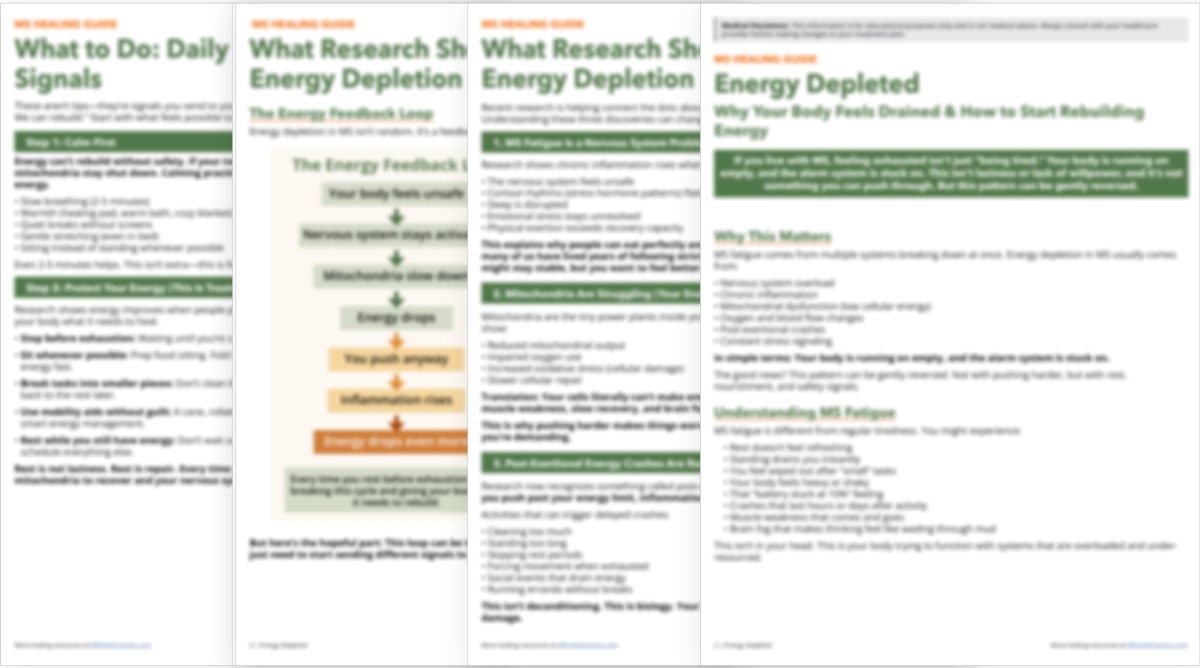
The Energy Feedback Loop
A clear visual explanation of why the cycle keeps repeating — and the simple truth that breaking it starts with rest, not effort.
🔬
The Research Made Simple
What science says about nervous system activation, mitochondrial dysfunction, and post-exertional crashes — in plain language.
🌿
Daily Energy Rebuild Signals
Simple calming practices that tell your mitochondria it’s safe to restore energy — slow breathing, warmth, quiet breaks, gentle stretching.
⚡
Daily Energy Rebuild Energy Protection Strategies
How to stop before exhaustion, sit whenever possible, break tasks into pieces, and use supports — all framed as smart biology, not defeat.
🥗
Feed Your Mitochondria
The specific foods that support cellular energy production and reduce oxidative stress. No perfect diet required — just gentle direction.
📝
Energy Pattern Tracker
A simple daily tracker to notice what drains you, what restores you, and where your energy envelope actually is.
“Your mitochondria aren’t lazy — they’re starved for the right signals. Your nervous system isn’t defective — it’s stuck in protective mode. Your crashes aren’t weakness — they’re biology. You don’t need to push harder. You need to work with your body, not against it.“
— From the guide, MSintheCountry.com
HOW TO USE THIS GUIDE
Build Slowly.
Layer by Layer.
The guide gives you a gentle 8-week framework. Don’t try to do everything at once — that depletes energy and defeats the purpose.
Week 1–2: Start with calming
Pick one daily calming practice and do it every day. Energy can’t rebuild without safety — so this always comes first.
Week 3–4: Practice energy protection
Start stopping before exhaustion. Sit whenever possible. Rest while you still have something left. Keep the calming practice going.
Week 5–6: Feed your mitochondria
Add one energy-supporting food daily — a cup of leafy greens, some berries, a handful of pumpkin seeds. Small additions compound over time.
Week 7–8: Reduce one energy drain
Better sleep timing, less screen light at night, less clutter, less doom-scrolling. Pick one. Your energy reserves will be noticed.
Ready to Start Pushing
and Start Rebuilding?
You don’t need to fix everything at once. Start where you are. Pick one calming practice. Rest before you crash. Add one energy-supporting food. These aren’t small things — they’re signals to your body that restoration is allowed.
$3.99
One-time · Instant PDF Download
✓ Instant download ✓ Print or use on any device ✓ No subscription
Instant Download Notice: This guide is delivered immediately as a digital download. For that reason, purchases are final and refunds aren’t available.
Medical Disclaimer: This guide is for educational purposes only and is not medical advice. Always consult your healthcare provider before making changes to your treatment plan. · MSintheCountry.com